
Close Menu

Paid media campaigns really depend on solid user experiences, and responsive web design is a huge part of that. When your ads send folks to a website that just works, no matter what device they’re on, they’re way more likely to stick around and actually convert. 

A responsive website gives your paid media a real shot at success across all screen sizes, especially mobile, where most of your traffic probably comes from these days.

Mobile responsive ads and optimized landing pages cut bounce rates and speed up load times. That helps your ad quality scores and ROI. If your site isn’t responsive, you’re just throwing away potential customers who get frustrated with slow or clunky pages on their phones.

Brands that nail responsive design get smoother branding and reach more people. You don’t have to pay for a bunch of different site versions, either. It’s just a smarter, more efficient way to keep up with how people actually browse.

Key Takeaways

  • Responsive design boosts ad engagement by working on all devices.
  • Mobile-optimized ads lower bounce rates and lift conversions.
  • Consistent, scalable design helps paid media keep winning long-term.

The Critical Role of Responsive Web Design in Paid Media Results

Responsive web design shapes how your paid media campaigns perform. When your site works smoothly on mobile, loads fast, and connects ads to landing pages without a hitch, you’re set up for more conversions. All these little details add up and make a big difference in your results.

How Responsive Web Design Boosts Paid Media Performance

Responsive web design means your site looks good and works well on any screen, especially phones, which now get most of the clicks anyway. When landing pages adjust on the fly, people get faster load times and easier navigation. That keeps them from bouncing and helps them move down the funnel.

Better mobile usability just makes people happier, and happy visitors are more likely to do what you want, like fill out a form or buy something. Responsive sites also help with core web vitals, so you get better page rankings and ad quality scores. That can mean lower ad costs and more eyeballs on your ads. It’s a win-win for your ad spend and conversion rates.

Mobile Optimization for Paid Ads and Landing Pages

Mobile optimization isn’t just about shrinking stuff down. It’s about making sure ads and landing pages load super fast and look right, without weird errors. Slow or buggy mobile pages are a surefire way to lose people.

Google cares a lot about page speed for ad rankings. If your landing page is slow, people bail before you even get a chance. Mobile-friendly designs that keep images and scripts light help you win those precious seconds and keep users moving from ad to page without friction.

A solid mobile landing page keeps things simple and makes actions, like buying or signing up, easy. Less hassle means more conversions. That’s why mobile optimization is just non-negotiable for paid media.

Responsive Design Strategies for Mobile-First Campaigns

Mobile-first design puts mobile users right at the center. It’s about keeping things simple, clear, and quick to find, even on a tiny screen. That’s where your audience is anyway.

Good strategies use flexible grids, scalable images, and content that adapts to whatever device people have. Testing on lots of devices helps you spot problems before launch. If mobile usability feels seamless, people move through your conversion funnel without getting stuck.

When you focus on mobile users first, you get more engagement and better conversion rates. Responsive design that follows mobile-first thinking helps your paid media campaigns deliver better returns because everything just works, no matter where people find you.

Want to dig deeper? Check out The Importance of Responsive Web Design in 2025.

Key Benefits and Best Practices of Responsive Web Design for Paid Media

Responsive web design helps your paid media work by making sure ads and landing pages don’t break on any device. You get lower bounce rates, faster load speeds, and a boost for your SEO. Developers use flexible layouts and smart tools to keep sites easy to update and ready for the future.

Improved User Experience Across Devices

Responsive design uses fluid grid layouts and flexible images that automatically fit any screen. No more awkward scrolling or weird navigation. Mobile users especially love big, easy-to-tap buttons and simple menus. That’s what gets them interacting with your ads and landing pages.

Fast-loading pages keep people from bouncing, which is huge for paid campaigns. When visitors stick around and click more, you see better conversion rates. CSS media queries help content rearrange for different screens, so everyone gets a good experience no matter what device they’re on.

SEO and Mobile-First Indexing Advantages

Search engines love mobile-optimized sites, and mobile-first indexing is the new normal. Responsive websites that load fast, look right, and keep content consistent dodge penalties for duplicate content and bad usability. That means better SEO rankings and more organic traffic, so you don’t have to rely only on paid ads.

Performance tricks like caching and compressing images also help with faster load times (and Google notices). Running just one responsive site saves time and money compared to juggling separate desktop and mobile versions. Plus, it helps your search rankings and ad quality scores.

Tools and Frameworks to Build Responsive Sites

Frameworks like Bootstrap, Foundation, and Tailwind CSS make it easier to build responsive layouts. You get pre-made components, so you spend less time coding and more time making sure your site works everywhere.

Testing tools like BrowserStack, Responsinator, and Google Mobile-Friendly Test let you see how your site looks on different devices. Catching issues early means your ads and content won’t flop. Keep an eye on things with analytics, too, so you know performance stays solid.

Mixing these tools with best practices, like CSS media queries and smart image optimization, gets you responsive sites that load fast, keep users happy, and make your paid media campaigns work harder for you.

Frequently Asked Questions

Responsive web design makes your ads look and work better across all devices, especially phones and tablets. It helps your website adapt to any screen size, so ads are easier to see and click. That flexibility leads to better engagement and, hopefully, more conversions.

How does responsive web design enhance the user experience for mobile ad viewers?

Responsive design ensures every ad click leads to a page that loads correctly and feels natural to use. Touch-friendly navigation, scalable images, and readable layouts all reduce bounce rates. 

If you need help identifying mobile UX issues, our team can review your site and recommend improvements that directly support your paid media results.

What are the advantages of using responsive design in improving conversion rates from paid media campaigns?

When mobile visitors land on pages that fit instantly, they’re far more likely to complete the action your ad promised. A single, responsive site strengthens SEO, lifts ad quality scores, and builds trust through consistent design. 

Many brands partner with Impremis to fine-tune responsive layouts that increase form fills, sales, and overall campaign efficiency.

In what ways does mobile optimization of ads affect click-through and engagement rates?

Mobile-optimized ads load quickly and look clean on any device, which helps users understand your message without extra friction. Clear layouts and fast responses drive higher engagement and stronger CTRs. 

If improving mobile performance feels overwhelming, you can always reach out for expert support in aligning ad creative and landing pages.

Improve Your Responsive Experience to Boost Paid Media Results

A responsive, mobile-ready website makes every ad perform better. If you’re ready to tighten load times, fix mobile friction, or refine your landing pages for higher ROI, the team at Impremis can help you build a smoother experience that strengthens your paid media performance.

Whether you need a full responsive redesign or targeted updates to improve engagement, you can connect with our web experts for guidance built around your goals. 

Better responsiveness means better conversions, and it starts with the right support.

Every e-commerce site wants higher conversion rates, right? UX design is at the heart of getting there. If your site’s navigation is clear, loads fast, and feels easy to use, you’re already nudging visitors closer to buying. Good UX clears away the junk that stops people from finishing a purchase, so more visitors actually become customers.

UX isn’t just about making a site look pretty. It’s about making it work for real people, on any device. Trustworthy design, clear calls-to-action, and a mobile-friendly setup boost confidence and get folks clicking. If you stick to proven UX best practices, you’ll keep people coming back, and you won’t need to blow your budget on ads.

People expect online shopping to be smooth and hassle-free. Regular testing and tweaks help your site keep up. Here are five UX design principles that’ll make your e-commerce experience better and get those conversion rates up.

Key Takeaways

  • Simple, clear design leads to more clicks and more sales.
  • Trust signals and mobile-friendly layouts make shoppers feel safe.
  • Testing and tweaking keep conversions growing.

Essential UX Design Principles for Higher Website Conversion

Want more conversions? It comes down to smart design choices. You need clear signals that guide users to the right actions. Navigation should just make sense; no one likes getting lost on a site. Trust grows when people see proof you’re legit and that their info’s safe.

Mobile and responsive design keep things smooth, no matter what device someone’s using. That keeps people engaged and less likely to bail.

Clear Calls-to-Action and Optimized CTA Placement

Calls-to-action (CTAs) are your money-makers. They need to be obvious, short, and tell people exactly what to do, think “Buy Now” or “Get Your Quote.” If your button language is active, people hesitate less and click more.

Where you put CTAs matters, keep them above the fold so nobody misses them. Use a color that pops and give the button some breathing room. Don’t cram the page with too many CTAs; one clear goal per page is enough.

Try out different button colors, words, and sizes with A/B testing. You’ll see what your audience actually likes, not just what you think works.

Streamlined Navigation and Intuitive User Journey

Navigation should make the user journey easy. Menus work best with 5-7 main items; more than that and people get overwhelmed. Stick to labels everyone recognizes so nobody has to guess.

Group related pages together. Most users expect the menu up top or on the left. Add a search bar for folks who know exactly what they want.

Keep things flowing. The fewer hoops users jump through, the more likely they’ll stick around and buy. Use familiar design patterns so people know what to expect.

Building Trust Through Social Proof and Trust Signals

Trust is everything. If your site feels reliable, people are way more likely to buy. Show off testimonials, reviews, or case studies; let your happy customers do the talking.

Display SSL icons, payment badges, and partner logos to show that you take security seriously. Stick to consistent colors, fonts, and tone for a professional vibe.

Be clear and honest in your messaging. If people believe you’ll deliver, they’ll stick around and convert.

Responsive and Mobile-Optimized User Experiences

Mobile traffic is huge now. If your site isn’t responsive, you’re missing out. Mobile layouts should focus on what matters: big buttons, easy navigation, and no clutter.

Start designing for mobile first, then scale up. Avoid heavy graphics that slow things down. Fast load times and simple touch controls keep users happy.

Test your site on real devices, not just emulators. Responsive design shows you’re serious, and it builds trust no matter what device people use.

Want to dive deeper into high-converting CTAs? Check out this UX design guide for conversions.

UX Best Practices for E-commerce Conversion Optimization

Great ecommerce design guides users with clear priorities and easy-to-read content. Use graphics and copy that highlight what matters, don’t overwhelm shoppers. A smooth path to purchase means more sales and better feedback for ongoing tweaks.

Visual Hierarchy and Effective Use of Graphics

Visual hierarchy shows users what matters most. Bigger fonts, bold headlines, and bright colors pull attention to CTAs like “Add to Cart.” It helps people find what they want fast.

Use sharp product photos from different angles. Lifestyle pics can build trust and help people picture themselves using your stuff. Every graphic should have a purpose; ditch anything that just adds clutter.

White space and straight alignment keep things clean. Grids help organize content. When you combine a strong hierarchy with the right graphics, users move smoothly through your site and checkout.

Color Schemes, Typography, and Readability

Colors set the mood and shape your brand. Contrasting colors make CTAs stand out and get more clicks. Stick to neutral backgrounds with pops of color for action items.

Pick fonts that are easy to read, sans-serif usually works best online. Make sure text is big enough, especially for product info and buttons.

Space out lines and break up paragraphs. Use bullet points and short sentences to make info skimmable. Nobody reads giant blocks of text. Consistent styles build your brand and make the site easier to use.

Accessibility and Progressive Disclosure

Accessibility means everyone can use your site, including people with disabilities. Design for keyboard navigation, screen readers, and color blindness. You’ll reach more people and get more sales.

Progressive disclosure keeps things simple. Show the basics first, then let users click for more details. For example:

  • List main specs up front, with “More Details” sections
  • Hide long policies, but link to them clearly
  • Only show extra form fields when needed

This gives users control and keeps them from feeling overwhelmed.

Continuous Improvement: Analytics, User Feedback, and A/B Testing

Check your site data often. See where people drop off and what’s working. Look at click rates, cart abandonment, and how long people stick around.

Ask users for feedback with surveys or usability tests. They’ll tell you what’s tripping them up, stuff you might never notice just looking at numbers.

Run A/B tests to compare different pages or elements. Try new button colors, words, layouts, or checkout flows. Let real results guide your choices.

Keep cycling through analytics, user insights, and testing. That’s how you keep conversions climbing and your ecommerce business growing. Want more strategies? Check out e-commerce UX best practices.

Frequently Asked Questions

Good UX design for e-commerce means clear navigation, quick load times, and trust signals that help users buy with confidence. Optimizing CTAs and making sure the site works on mobile are also huge for getting more conversions.

What are the top 5 UX design principles that can significantly improve e-commerce conversion rates?

First, keep navigation simple so shoppers find products fast. Fast-loading pages keep people from bouncing. Clear, bold CTAs nudge users to finish a purchase.

Trust signals like secure payment badges and consistent branding build credibility. And mobile optimization is a must, since more people shop on their phones every year.

How can UX design influence the conversion optimization process for websites?

UX design shapes every step of the customer journey. It removes blockers and makes the next steps obvious. Smart UX means testing layouts, copy, and button spots to see what actually gets results.

Easy-to-scan content and persuasive copy help answer questions and calm doubts, raising conversion rates. Keep analyzing and tweaking to stay ahead.

What are the best practices in UX for enhancing user engagement and conversion on e-commerce platforms?

Start with intuitive menus and a search that actually helps people find what they want fast. High-contrast buttons and links? Those make calls-to-action pop; no one should miss them.

Add alt text to images so everyone can shop, and show real customer reviews to boost trust. Keep form fields short, especially on mobile; nobody likes a checkout that takes forever.

When you sweat the small stuff, you create a seamless shopping experience that brings people back and nudges them to buy. If you’re not sure where to start, maybe it’s time to call in some web design pros who know these tricks inside out.

Optimize Your Website Experience With Expert Support

Improving UX is one of the fastest ways to lift conversions, but many teams aren’t sure which changes will make the biggest impact. 

If you want clearer navigation, stronger CTAs, or a smoother mobile experience, the team at Impremis can help you refine your site with data-backed improvements that move real numbers.

Whether you’re working on a full redesign or need quick wins that boost conversions fast, you can connect with our UX specialists for tailored guidance. A better user experience leads to better sales, and it starts with the right partner.

If you’re running a startup, a strong brand strategy isn’t just nice to have; it’s pretty much make-or-break for fast growth. With a focused brand strategy, you can connect with the right people, build trust, and carve out a unique spot in the market. Without that, scaling just feels like pushing a boulder uphill.

Brand growth starts by figuring out what your startup stands for and who you’re actually serving. Once you’ve got that, you can roll out consistent messaging, standout visuals, and stories that stick. That’s how you get noticed by customers and investors, too.

Brand development isn’t just about a cool logo or a catchy name. It’s about shaping an experience that scales with your business. This gives you an edge and helps you scale way faster.

Key Takeaways

  • A focused brand strategy connects you with your ideal audience.
  • Consistent messaging and visuals boost brand awareness.
  • Good brand development accelerates growth and makes it more sustainable.

Core Elements of a High-Growth Startup Brand Strategy

If you want a brand strategy that actually works, focus on your purpose, your audience, and your market position. These three pieces keep things clear and give you a solid base for growing fast. Skip them, and you’ll just blend in with everyone else.

Defining Your Brand Purpose and Mission

Your brand purpose goes way beyond making money. It’s about the bigger goals or values your company stands for. The mission puts that purpose into action with real steps toward your vision. Getting clear on both keeps your team moving in the same direction.

Write short, meaningful statements about your core values and long-term goals. This makes your messaging sharper and attracts people who care about the same things. A clear purpose also helps you explain why your startup matters, which builds trust right from the start.

Identifying and Engaging Your Target Audience

Knowing your target audience means digging deeper than age or location. Find out how they think, what bugs them, and what they really need. This lets you speak their language and build stuff they actually want.

Start with market research, think surveys, interviews, even some people-watching if you have to. Build those buyer personas and stay focused on a tight niche. When you know your audience, you can create things that keep them coming back and telling their friends.

Developing a Unique Value Proposition

Your unique value proposition (UVP) is your answer to “Why you?” It’s how your product or service solves a problem better than anyone else. Make it simple and keep it consistent across all mentions of your brand.

Check out what competitors offer and listen to your customers. Use their feedback to shape a UVP that really stands out. This becomes the backbone of your brand and sales; it’s what helps you cut through the noise.

Building an Effective Brand Positioning

Brand positioning is the spot you want in people’s minds when they think of your space. It’s about what makes you different, the emotional vibe you give off, and how you want people to see you.

Stick to consistent messaging, visuals, and experiences that match your purpose and UVP. That’s how you stay clear in a crowded market. When you nail this, people remember you and trust you. That’s huge for scaling up.

Excellent positioning can even turn your audience into fans who do your marketing for you. That keeps your growth costs down and helps you grow for the long haul.

Practical Strategies to Scale Startup Brand Growth

If you want your brand to grow fast, make clear choices about how it looks, sounds, and connects with people. Then, keep those choices steady across every customer touchpoint. That’s the bedrock for trust and loyalty as you get bigger.

Establishing a Memorable Brand Identity

A strong brand identity helps you stand out. Your logo, colors, fonts, and other visuals all work together to show off your values and brand personality.

Set up brand guidelines so everyone’s on the same page. Whether it’s your website or a flyer, the look should feel like you. A clear identity makes you easier to recognize and trust, and that’s rocket fuel for growth.

Crafting a Consistent Brand Voice and Messaging

Your brand voice is how you talk to customers, word choice, tone, and even attitude. Make sure it matches your values so people feel a real connection. If you keep your messaging steady across channels, your brand feels solid and reliable.

Build a messaging framework to help your team stay on track. Keep checking in with customer feedback so you can tweak your voice as you learn. When you get this right, customers see you as relatable and trustworthy.

Maximizing Brand Awareness and Customer Trust

Smart marketing gets your startup in front of more eyes. Pick the right channels and keep your message consistent to boost awareness. Get involved with your customers and connect with influencers to build credibility.

Check in regularly to see how people view your brand. Use that info to stay fresh and fix what’s not working. When you mix awareness with trust, you build a loyal base that keeps you growing.

Want more ideas? Check out the brand strategy for startups.

Frequently Asked Questions

If you want your brand to grow fast, set clear goals, use consistent messaging, and connect with the right people. Dodge the usual mistakes and focus on what matters most for your brand.

What are the essential elements to include in a startup’s brand strategy for rapid scaling?

Start by defining your purpose, values, and what makes you unique. These are the building blocks of a strong brand identity that really clicks with your audience.

Keep things consistent across touchpoints, product, marketing, and customer service. That’s how you build trust and make scaling smoother.

How can a startup effectively communicate its brand identity to stand out in a crowded market?

Focus on simple, clear messaging that shows what makes you special. Share stories that connect emotionally with your customers, and they’ll remember you for it.

Use the channels your audience prefers and keep your voice steady. That’s how you boost visibility and get people engaged.

What branding mistakes should startups avoid to ensure sustainable growth?

Jumping straight to design or ads without a real brand strategy? That’s a recipe for confusion and wasted money. If you don’t get your audience, you’ll end up with weak connections, and people just won’t trust you.

When your messaging is all over the place, or you don’t deliver what you promise, your reputation takes a hit. Trying to please everyone? That just waters down what makes your brand special.

Strengthen Your Brand Strategy With Expert Guidance

Scaling a startup brand takes clarity, consistency, and a strategy that grows with your business. If you’re ready to refine your identity or build a stronger foundation for long-term success, the team at Impremis can help you move with confidence.

Whether you need support defining your positioning, aligning your messaging, or elevating your brand visuals, you can connect with our experts for tailored guidance. A strong brand is one of the most powerful growth tools a startup can invest in.

Building brand authority requires more than just great products or services; it takes a strong presence that earns trust and credibility. Multimedia content marketing is a powerful way to grow brand authority by using videos, podcasts, infographics, and webinars to engage audiences deeply. Using different types of multimedia content strategically helps brands stand out as industry leaders and trusted sources.

Brands that invest in multimedia content create more meaningful connections with their audience, making complex ideas easier to understand and remember. This approach not only increases visibility but also builds lasting relationships by sharing authentic stories and valuable information. The right mix of content formats can position a brand as knowledgeable and dependable in its field.

To succeed, companies must use clear strategies to produce, promote, and measure their multimedia efforts. This ensures content reaches the right audience and drives growth. A well-planned multimedia content marketing approach is key to growing brand authority in today’s competitive market.

Key Takeaways

  • Strategic multimedia content boosts brand credibility and engagement.
  • Diverse content formats help communicate complex ideas clearly.
  • Measuring and promoting content ensures sustained brand growth.

Strategic Use of Multimedia Content for Building Brand Authority

Effective multimedia content combines various formats and storytelling methods to engage the target audience and establish trust. A well-planned content strategy uses different types of media to showcase expertise and connect emotionally. Collaborations with influencers can extend reach and credibility. The right mix of visual, audio, and interactive content strengthens brand identity and fosters lasting audience relationships.

Key Types of Multimedia Content for Brand Growth

Brands can leverage several critical types of multimedia content to build authority. Videos remain a top choice for storytelling, providing emotional connections through visuals and sound. They include tutorials, testimonials, and behind-the-scenes footage that humanize the brand. Podcasts offer in-depth discussions and thought leadership opportunities, allowing brands to share expert insights authentically.

Infographics and interactive content simplify complex data and invite active audience participation, improving understanding and retention. Meanwhile, blogs and whitepapers deliver detailed information, backing a brand’s expertise with research and case studies. Webinars combine education and interaction, generating leads and boosting visibility.

Using a diverse set of formats helps reach different audience preferences, increasing overall engagement and solidifying brand authority.

Developing an Effective Content Strategy

An effective multimedia content strategy begins with understanding the target audience’s needs and preferences. Creating a detailed content calendar allows consistent posting across multiple channels, ensuring that content supports longer-term brand goals.

The strategy must balance educational content like how-to videos or whitepapers with interactive experiences such as polls or quizzes. Measuring engagement through metrics like views, shares, and comments guides content refinement. Timing and platform choice are crucial, short videos may perform best on social media, while in-depth case studies belong on the brand’s website.

Brands should align content with their core values and messaging for a consistent brand identity. Clear objectives, like increasing brand awareness or generating leads, help shape content themes and formats.

Amplifying Brand Authority Through Storytelling and Authenticity

Storytelling is vital in making multimedia content memorable and trustworthy. Brands that use authentic storytelling create emotional connections that foster loyalty. Sharing real customer testimonials, case studies, and behind-the-scenes content shows transparency and builds credibility.

Effective storytelling combines factual information with relatable narratives to humanize the brand. This can include challenges overcome, innovations introduced, or personal experiences behind the products. Visual and audio elements enhance these narratives, making them more engaging.

Authenticity means avoiding overly polished or sales-heavy messages. Instead, brands focus on genuine communication, aligning stories with their mission and values. This approach strengthens the brand’s reputation as a thought leader and trusted source.

Collaboration With Influencers and Thought Leaders

Partnering with industry influencers and thought leaders enables brands to reach wider and more relevant audiences. These collaborations add social proof and can improve brand perception by association.

Influencers can contribute through guest podcasts, interviews, or co-created content such as videos and webinars. Their endorsement often encourages audience trust and engagement, especially when the influencer shares aligned values with the brand.

Brands can also encourage user-generated content, such as reviews and testimonials, to deepen community involvement and amplify messaging organically. Building relationships with influencers and thought leaders helps maintain ongoing content contributions that continuously elevate brand authority.

Such partnerships offer opportunities for authentic storytelling and expert insights, reinforcing the brand’s position in the market.

Optimizing, Promoting, and Measuring Multimedia Content for Brand Growth

Effective use of multimedia requires careful planning and ongoing analysis. Success depends on optimizing content for search engines, distributing it across the right channels, measuring how audiences engage, and using data to scale authority with original insights.

Implementing SEO and Distribution for Maximum Brand Visibility

To boost brand visibility, multimedia content must be optimized with targeted keywords identified through tools like BuzzSumo and Answer the Public. Using relevant keywords in titles, descriptions, and metadata improves organic traffic and ensures content appears in search results.

Distribution is equally important. Sharing content across owned platforms like websites and blogs, as well as third-party channels, expands reach. Combining digital PR strategies with backlinks increases authority and drives referral traffic. Repurposing multimedia content into various types, such as videos, infographics, and podcasts, targets different audience preferences.

Ensuring fast page loading times and mobile-friendly layouts helps improve user experience and SEO rankings. Overall, deliberate SEO and multi-channel distribution work together to maximize visibility and attract quality audience interactions.

Tracking Engagement and Analyzing Content Performance

Using Google Analytics and other analytics platforms provides critical insights into engagement metrics such as views, bounce rates, average watch time, and conversion rates. Monitoring these helps identify what content types resonate best and how audiences interact.

Tracking assists in optimizing future material and adjusting distribution strategies. For example, if data shows users engage more with quizzes and polls, content creators can emphasize interactive elements to increase participation.

Measurement also highlights lead generation success by linking content interaction to sign-ups or purchases. Regular review of performance metrics supports data-driven decision-making to refine content marketing strategies and build stronger brand authority.

Leveraging Social Media and Email Marketing

Social media platforms serve as essential hubs for promoting multimedia content. Consistent posting, using trending hashtags, and engaging with followers grow community size and improve brand recognition.

Platforms like LinkedIn and Instagram can drive targeted traffic by sharing original videos, live streams, or behind-the-scenes content. Encouraging shares and comments increases organic reach.

Email marketing complements social media by directly reaching subscribers with personalized content. Segmenting lists based on interests allows delivery of relevant multimedia, increasing open rates and conversions.

Together, social media and email marketing reinforce brand presence, nurture customer loyalty, and amplify content impact.

Scaling Authority With Original Research and Data-Driven Insights

Creating original research and educational multimedia content positions a brand as an industry leader. Publishing unique data studies or a how-to video series builds trust and attracts backlinks that improve SEO.

Sharing these insights through webinars, podcasts, or infographics enables small businesses and larger brands alike to demonstrate expertise. It also encourages mentions in digital PR campaigns, further enhancing authority.

Using data-driven insights to create highly relevant, high-quality content aligns with audience needs and current trends. This approach strengthens brand authority while providing valuable resources that support long-term growth and customer engagement.

Frequently Asked Questions

Multimedia content comes in many forms, each serving a unique role in establishing brand authority. Knowing how to track its effectiveness and plan its use strategically is essential for sustained brand growth.

What types of multimedia content are most effective for enhancing brand authority?

Videos that tell stories or demonstrate expertise are highly effective. Webinars allow brands to showcase knowledge and interact with their audience in real time.

Podcasts provide a platform for authentic conversations, positioning brands as trusted voices. Interactive infographics and tutorials help explain complex ideas and engage users more deeply.

How can I measure the impact of multimedia content on brand growth?

Engagement metrics such as views, shares, comments, and likes give a clear picture of audience interest. Conversion tracking, like sign-ups or sales, shows how content drives action.

Video analytics reveal how long viewers stay engaged and which parts resonate most. Combining data from multiple platforms offers the best insight into overall content performance.

What strategies can be employed to integrate multimedia content effectively into a content marketing plan?

It is important to create a balanced mix of formats that suits the target audience’s preferences. Repurposing content across videos, podcasts, infographics, and blogs maximizes reach.

Distributing multimedia on social media, email campaigns, and industry partnerships ensures wider visibility. Consistent, high-quality educational content helps establish ongoing authority in the market.

For a deeper look at these strategies, see multimedia content marketing tactics for brand growth.

Strengthen Your Brand Authority With Expert Support

Growing brand authority takes more than great content; it requires a strategy built on consistency, clear messaging, and creative execution that stands out. If you’re ready to elevate your multimedia approach and build a stronger market presence, the team at Impremis can help you move with confidence.

Whether you need support refining your content strategy or scaling production, you can reach out to our experts for tailored guidance. With the right partners, your brand can grow faster and earn lasting trust.

Branding is more than a logo or a color scheme. But many businesses treat it like one. 

When branding is weak, inconsistent, or misaligned, paid advertising, no matter how well-targeted or well-funded, struggles to deliver. 

This results in wasted ad spend, poor conversion rates, and shrinking returns.

In this article, readers will discover:

  • Why branding mistakes often show up as underperforming ads
  • Key branding issues that directly hurt paid advertising ROI
  • Real-world examples and data to highlight the damage
  • Actionable fixes to shield your ad campaigns from branding-driven loss

Why Branding Matters for Ad Performance

Paid advertising can generate clicks and impressions. But conversions depend on trust, recognition, clarity, and emotional connection, all of which are built through branding.

  • A brand must deliver a consistent message and visual identity across all touchpoints so potential customers trust what they see. Inconsistent branding “silently drains ROI” when assets like logos, tone, or design feel different across channels.
  • Branding shapes how people perceive quality, value, and trust before they even click. Research on advertising and brand attitudes shows that ads contribute to perceived quality and value, which influences purchasing decisions over time.
  • Because paid advertising often targets new audiences, people who don’t know your business, branding becomes a critical credibility filter. Without consistent and strong branding, ads may attract attention but fail to convert.

Common Branding Mistakes That Hurt ROI

MistakeWhy It Kills Ad ROI
Inconsistent brand identity across channels (logo, tone, visuals)Confuses or undermines trust, users may not realize the landing page is from the same brand as the ad. 
Vague or undefined brand positioning / value propositionAds drive clicks but fail to communicate what makes the brand unique, leading to low conversion and weak retention.
Over-emphasis on ads without building brand equityShort-term results may appear, but long-term brand recognition and loyalty suffer, reducing overall ROI potential.
Ignoring user experience, consistency in design, and UX across channelsEven high-click ads fail if the website or landing page feels low quality or misaligned, reducing conversions.
Lack of a clear brand strategy and brand guidelinesWithout guidelines, different teams or campaigns produce divergent messaging, and fragmentation weakens message clarity and conversion power.
Treating branding as decoration instead of a strategic assetBrands that treat branding as “optional styling” rather than core messaging often underinvest in cohesion, hurting long-term ad performance and perception.

How Branding Mistakes Show Up in Paid Advertising

Wasted Budget on Clicks That Never Convert

You might get high click-through rates (CTR) but low conversion rates. That often signals branding issues; people click because the ad got attention, but once they land, they don’t feel confident or aligned with the brand.

Poor Customer Retention and Weak Lifetime Value

If first interactions feel disconnected or confusing, people may buy once, or even not at all. Even if they do, weak brand identity reduces the likelihood of repeat business or referrals.

Difficulty Scaling Campaigns

When branding is inconsistent, each new campaign becomes harder to launch. Teams waste time recreating assets, and messaging loses potency. Over time, this fragmentation erodes the compounding benefit of brand awareness.

Misaligned Expectation vs. Experience

Ads can set expectations, but if the delivered product or website feels cheap, mismatched, or confusing, trust breaks. That mismatch can cause bounce, high return rates, or negative brand perception.

Why Brands Often Underestimate Branding’s Impact on ROI

  • Because branding feels intangible and long-term, many treat it as optional decoration rather than a core strategy. Recent commentary warns that “brand building” is often misused as a performance metric rather than a foundation.
  • Marketing metrics tend to focus on immediate, measurable gains (clicks, leads, conversions). But branding’s benefits, trust, recognition, and lifetime value unfold over months or years.
  • Without tracking brand equity, perceived quality, or emotional connection, marketers may never notice the slow leak of ROI caused by poor branding. Studies in digital brand equity suggest traditional digital metrics (like clicks, impressions) don’t fully capture brand strength.

How to Fix Branding Mistakes and Protect Your Ad ROI

Define and Document Your Brand Strategy

  • Clarify your brand mission, core values, promise, and ideal audience.
  • Write a brand positioning statement that sets you apart from competitors.
  • Create a brand guideline (logo use, color palette, typography, tone, imagery, voice) to ensure cohesion across all channels.

Audit Existing Assets and Channels for Consistency

Check your:

  • Ad creatives (social ads, display banners)
  • Landing pages and website pages
  • Email campaigns and social media presence

If you find inconsistencies, update them so they reflect a unified identity.

Align Ads, Website, and User Experience Design

Your ad should lead to an experience that matches the ad’s tone and visual identity. Design, messaging, and UX should feel seamless. This reduces friction and builds trust.

Monitor Brand Signals, Not Just Clicks

Track metrics beyond click-through and conversions. Watch for:

  • Bounce rate differences between branded and unbranded campaigns
  • Repeat visit rate and customer loyalty
  • Brand recall and recognition over time (surveys, feedback)

Combine Brand Building with Performance Marketing

Don’t treat branding and performance ads as separate. Use brand-strengthening content and paid campaigns together. Balanced investment builds both short-term performance and long-term brand equity.

Practical Checklist, Branding & Ad ROI Fixes

  • Write or refine your brand positioning and value proposition
  • Build a comprehensive brand guideline document
  • Audit all creative assets for consistent visuals and tone
  • Align ad-to-landing page experience (design, copy, messaging)
  • Set up brand-level tracking (e.g., bounce rate, repeat customers, brand recall)
  • Plan future campaigns with blended brand + performance marketing

Frequently Asked Questions

Why does a brand that looks “good enough” still hurt my ad performance?

Even when branding “looks good,” inconsistency or weak positioning can undermine trust. 

Visitors might click but still hesitate because the visuals, messaging, or tone don’t match their expectations. 

Impremis helps resolve that by aligning design, UX, and branding, so every ad translates to trust and conversions.

Can good branding really improve ad ROI even if my ads are targeting well?

Yes. Targeting gets attention. Branding gives legitimacy. 

Without a strong brand foundation, consistent identity, messaging, and clarity, even well-targeted ads underperform. 

Impremis’s branding-design and conversion-rate optimization services ensure your brand presentation matches your targeting strategy.

How soon will I see results after fixing branding mistakes?

Branding improvements often show in ad performance quickly, reduced bounce rates, better conversions, and improved post-click engagement. 

Over time, you’ll also notice stronger brand recall, higher customer loyalty, and lower acquisition cost. 

With Impremis’s full-stack design and marketing capabilities, these gains compound faster.

Take the First Step Toward Positive Ad ROI

Fixing branding isn’t optional; it’s essential. A strong, consistent brand transforms every dollar you spend on paid advertising into real business results. 

If you want help aligning your branding, design, and digital marketing strategy for maximum ROI, start by learning more about Impremis or reach out to discuss how you can elevate your brand and ad performance together.

Explore Impremis and our brand design services. Contact us here to begin building a brand that turns ads into conversions.

Every e-commerce store can sell products. Only a few build a brand identity that makes people come back, pay more, and tell their friends. A strong brand identity turns a store into a trusted name.

This guide shows exactly how to build brand identity for e-commerce and turn it into revenue, loyalty, and growth.

Key takeaways:

  • A well-defined brand identity increases recognition, trust, and willingness to pay premium prices.
  • E-commerce brand strategy must cover visuals, tone, values, and consistency across all touchpoints.
  • Following a clear brand-building framework helps ensure branding efforts boost revenue and long-term loyalty.

What Is Brand Identity, And Why Does It Matter for E-commerce

Brand identity is more than a logo and color palette. It covers how customers experience your business, visual design, tone of voice, values, messaging, and customer experience. 

For e-commerce stores, building brand identity is critical. Research shows that strong brand identity correlates with higher sales performance because customers rely on trust, recognition, and perceived quality when buying online. 

In saturated marketplaces, identity helps a brand stand out. Consistent brand presentation across channels increases recognition, reduces friction, and boosts customer trust, all of which drive conversions.

Core Elements of a Brand Identity That Converts

Building brand identity involves several essential components. For e-commerce, these elements must work together to create a cohesive, recognizable, and trustworthy presence.

Visual Identity

  • Logo design
  • Color palette
  • Typography and fonts
  • Packaging and product presentation
  • Website and mobile UX

Verbal Identity & Messaging

  • Brand voice and tone (friendly, professional, bold, etc.)
  • Tagline, mission statement, value propositions
  • Product descriptions, brand story, and copywriting style

Values & Customer Promise

  • Core values that resonate with target audience (e.g., quality, sustainability, community)
  • Consistent brand promise, what customers can expect every time they buy

Consistency Across Channels

  • Website, social media, product pages, email, ads, all aligned in look and voice
  • Uniform customer experience from first touch to post-purchase follow-up

These elements combine to build brand awareness and brand equity, intangible assets that build trust, justify pricing premiums, and increase loyalty.

A Framework: How to Create a Brand Identity for Your E-commerce Store

Here’s a practical, step-by-step framework you can follow to build a brand identity that drives revenue:

StepActionResult
1. Define your brand’s purpose, values & ideal customerIdentify what your brand stands for, who you serve, and what problems you solveClear direction and cohesive messaging
2. Craft visual identity elementsDesign logo, choose color palette and typography, layout packaging, and UIInstantly recognizable brand look
3. Develop your verbal identity & tone of voiceWrite tagline, brand story, consistent copy style (product descriptions, emails, ads)Consistent brand voice that resonates
4. Create brand guidelines & templatesDocument visuals + tone rules, build reusable templates for web, email, packaging, socialConsistency and scalable brand execution
5. Apply brand identity across all touchpointsUse the same visuals and messaging in ads, website, email, social, and product packagingUnified brand experience
6. Monitor, measure & iterateTrack metrics (conversion, AOV, customer retention, brand recall) and adjust where neededData-driven brand growth

This framework helps ensure your brand identity remains coherent and impactful, not just at launch, but as you scale and expand product lines.

How Brand Identity Translates to Revenue, Loyalty, and Growth

Brand identity isn’t just aesthetic. It affects real business outcomes, from pricing power to customer loyalty.

  • Willingness to pay premium prices: Strong brand identity communicates value beyond the product itself. Many shoppers are willing to pay more for brands they perceive as trustworthy or high-quality, which can be attributed to the brand trust shoppers have.
  • Higher conversion rates and lower acquisition cost: Recognized, trusted brands convert more visitors into buyers. Repeat customers and referrals reduce acquisition costs over time, a key effect of branding on products in business.
  • Customer loyalty and lifetime value: Brands that deliver consistent experiences build repeat buyers. That loyalty drives lifetime value, steady revenue, and word-of-mouth growth, highlighting the role of brand identity in customer retention.
  • Competitive differentiation: In markets crowded with similar products, a unique identity helps a store stand out, making it easier for shoppers to choose it over anonymous alternatives, a primary benefit of a strong brand identity.

Common Mistakes E-commerce Stores Make With Branding, And How to Avoid Them

Even good products can suffer when branding is weak or inconsistent. Here are frequent pitfalls, and how to steer clear:

  • Treating branding as a one-time step, instead of an ongoing strategy. Brands need to evolve but maintain their core identity. Regular audits and updates are essential.
  • Inconsistent visuals or messaging across channels, mismatched logos, color schemes, or tone confuse customers and erode trust.
  • Focusing only on logo or aesthetics, ignoring tone, values, packaging, user experience, and customer promise.
  • Neglecting brand guidelines, as teams grow, inconsistent execution becomes common without standards and templates.
  • Failing to align branding with product or customer expectations, brand identity must match what the target audience values (quality, affordability, sustainability, lifestyle, etc.).

Avoiding these mistakes helps ensure your brand identity stays strong as you scale.

E-commerce Brand Identity Tips You Can Implement Right Now

  • Start with a clear brand brief: define mission, values, target audience, tone, and visual direction.
  • Design a logo + color palette that reflects your brand personality and target customers.
  • Create templates for website, product pages, email marketing, ads, and social posts, all using the same visuals and tone.
  • Write product descriptions and copy that reflect brand voice and customer benefits, not just features.
  • Ensure your UX, packaging, and customer communication reflect your brand values (e.g., clarity, premium feel, sustainability).
  • Track key metrics such as conversion rate, repeat purchase rate, average order value (AOV), and customer feedback to validate brand impact.

For many businesses, a partner like Impremis helps by combining brand design, UX, and performance marketing so branding and revenue grow hand in hand.

Frequently Asked Questions

What exactly is included in “brand identity” for an e-commerce store?

Brand identity includes visual elements (logo, colors, fonts), verbal identity (tone, messaging, value propositions), brand values and promise, packaging and product presentation, and the overall customer experience across web, email, ads, and support. A well-rounded identity ensures every touchpoint reinforces the same brand impression.

How long does it take to build a brand identity that affects revenue?

It depends on scope, but basic brand identity (visuals + messaging + site UX) can be built in weeks. Results often show in the first 1–3 conversion cycles. Full benefits, like customer loyalty and brand equity, build over months. Working with Impremis can accelerate this process while aligning strategy, design, and performance marketing.

Can a small e-commerce store succeed without a strong brand identity?

Technically, yes, but it’s much harder. Strong brand identity helps even small stores appear credible, differentiate from competitors, and build trust quickly. With consistent branding, even a small store can improve conversion and retention rates. Impremis helps small businesses get brand-ready and marketing-ready at the same time.

Turn Your Store Into a Strong, Revenue-Generating Brand

If you’re serious about scaling e-commerce revenue, a strong brand identity is more than nice to have; it’s the foundation. Impremis can help design a cohesive identity, align branding with UX, build conversion-optimized design, and support full digital marketing integration.

Start building a brand that sells at premium prices and earns customer loyalty. Visit Impremis or reach out via our contact page to begin.

In today’s fragmented digital landscape, audiences no longer follow a single path. They jump between search engines, social platforms, social videos, and websites, and brands that mirror that journey see far stronger results. A well-executed cross-channel marketing strategy helps brands meet people where they are, amplify conversions, and scale performance.

In this article, you’ll learn how to:

  • Combine the strength of Meta, Google Ads, and TikTok into a unified campaign
  • Structure a multi-platform advertising plan that avoids wasted spend and audience fatigue
  • Use data, creativity, timing, and automation to deliver a seamless customer journey

Why Unified Digital Marketing Matters

Using multiple paid media channels is not new. But the difference between “multichannel” and “cross-channel marketing strategy” is coordination. Rather than treating each platform as a silo, cross-channel marketing ties them together to create a continuous, consistent customer journey.

When done right, this unified approach improves key metrics: 

In a world where privacy rules tighten, user behaviors shift fast, and audiences expect seamless experiences, integrated marketing plans are no longer optional. They give brands clarity, efficiency, and competitive advantage.

Core Principles: What Makes a Strong Integrated Marketing Plan

Before diving into platform-specific tactics, a solid plan should rest on the following foundations:

  • Unified data and tracking: Every touchpoint must feed into a centralized view of the customer. Without unified analytics, you lose the ability to truly measure full-funnel impact.
  • Consistent message and creative alignment: Branding, tone, and creative themes should remain coherent across platforms, even if formats vary (search copy, social video, display, etc.).
  • Channel-aware optimization: Each platform has unique strengths (search intent, social discovery, short-form video), but the campaign should treat them as parts of a single journey, not isolated efforts.
  • Scalable campaign management and governance: Use structured workflows, naming conventions, and possibly automation tools to manage campaigns across platforms without chaos.
  • Continuous measurement and iteration: Track results across channels, attribution, and user behavior. Adjust creatives, budgets, and sequencing based on data, not guesswork.

How Meta, Google Ads, and TikTok Complement Each Other

Each of these ad platforms brings unique advantages. When combined, their strengths cover more of the customer journey.

PlatformStrengthsHow It Fits in a Unified Plan
MetaExcellent for social reach, lookalike audiences, retargeting, and visually rich creativesUse Meta for top-of-funnel awareness, retargeting site visitors or engagers, and re-engagement campaigns.
Google Ads (Search, Performance Max, YouTube)Captures intent, covers search demand, and is integrated with search intent and discoveryUse Google to catch active intent (search), drive conversions, and support the upper-funnel with video (YouTube).
TikTokHigh engagement, short-form video, creative native formats, broad reach among younger demographicsUse TikTok for discovery, brand storytelling, engagement-heavy audiences, then retarget on Meta or Google.

By aligning these platforms, a brand can take a user from awareness (TikTok) → intent (Google search) → decision/retargeting (Meta), all while maintaining consistent messaging, creative, and data flow.

Step-by-Step Guide to Build a Unified Strategy

1. Define Clear Objectives and Audience Journeys

Start by defining what you want: brand awareness, lead generation, e-commerce sales, etc. Then map out your ideal customer journey across platforms:

  • Where do they first discover brands? (e.g., short-form video, social feed, or search)
  • Where do they research and compare? (e.g., Google search, YouTube, reviews)
  • Where do they convert? (e.g., website, landing page, checkout)
  • Where do they need reminders or retention flow? (e.g., retargeting ads, email follow-up)

Use those journey maps to decide when and where to deploy Meta, Google, and TikTok.

2. Unify Analytics and Attribution

Integrate your tracking tools, possibly using Google Tag Manager, UTM parameters, CRM, or a unified dashboard. This ensures you capture data from across platforms and see how they interact.

Use cross-channel analytics to:

  • Track the first touch, mid-funnel, and last touch conversions
  • See where drop-offs happen
  • Allocate budget to top-performing channels or combos

3. Align Creative and Messaging Across Platforms

Although formats vary, search ads, short-form video, display, and social posts keep core messaging consistent. Use similar hooks, value propositions, and brand identity. That way, users recognize your brand as they move across platforms.

For example: a TikTok video highlighting a problem + quick solution; a Google search ad that reinforces the same solution; a retargeting Meta ad offering a discount or CTA.

4. Leverage Automation and Campaign Management Tools

Modern cross-platform advertising demands strong campaign management. Use tools or processes that allow you to:

  • Launch or replicate campaigns across platforms with consistent naming and structure
  • Shift budgets dynamically, for instance, boost spend on Google when search demand spikes, or increase Meta retargeting when TikTok campaigns drive awareness.
  • Standardize creative, reporting, and optimization workflows across all platforms

5. Test, Optimize, and Iterate

Cross-channel campaigns are not “set and forget.” Regularly review performance data across platforms: conversion rates, click-through rates, ROAS, attribution.

  • Pause underperforming combinations
  • Reallocate budgets to high-performing flows
  • Refresh creatives especially for platforms with high ad fatigue (like TikTok and Meta)
  • Use insights from one platform to inform campaigns on others (e.g., a high-performing TikTok hook grabs attention, test that same hook in a Meta Story or Google video ad)

Common Pitfalls and How to Avoid Them

  • Treating each channel as separate silos leads to wasted spend and an inconsistent user experience
  • Using inconsistent creative or messaging weakens brand recognition across touchpoints
  • Poor data tracking or fragmented analytics make attribution and optimization nearly impossible
  • Ignoring governance, lack of naming standards, inconsistent budgets, and chaotic reporting
  • Over-relying on a single channel is risky, especially when algorithms or rules shift

By avoiding these pitfalls, marketers ensure their integrated marketing plan remains efficient, scalable, and resilient.

Frequently Asked Questions

How do you measure success across multiple advertising platforms?

Success comes from unified tracking and attribution. By combining data from all channels, paid social, search ads, video ads, and retargeting, brands can see which sequence of touchpoints leads to conversions. 

A unified dashboard or analytics system makes this manageable. At Impremis, we often tie paid media campaigns into our broader performance marketing and conversion rate optimization services to ensure every touchpoint moves toward business goals.

Should creatives be identical across Meta, Google, and TikTok ads?

Not identical, but aligned. Each platform demands a different format. A TikTok ad might be a short, raw video; a Google ad might be text or a YouTube video; a Meta ad might be an image or a carousel. The core message, tone, and value proposition should stay the same. 

That ensures a unified brand experience even as formats change. Impremis helps clients ensure their creatives stay coherent across channels while optimized per platform.

Is it better to focus on one platform first or start with all three at once?

It depends on resources, audience, and goals. Some brands may benefit from starting on the platform where their audience already spends time. Others may launch a full integrated campaign from the start to maximize reach and conversion. 

What matters more is planning the customer journey, tracking data properly, and being ready to iterate. Impremis often recommends starting with two platforms, such as Google Search and Meta retargeting, then layering in TikTok as awareness grows.

The First Step To Building Your Unified Strategy

An effective cross-channel marketing strategy turns scattered campaigns into a single, powerful engine driving awareness, conversion, and retention. 

If you’re ready to design a results-driven plan across Meta, Google, and TikTok, or want help unifying performance marketing, web design, and conversion optimization into one seamless system, explore what we offer at Impremis or contact us for a tailored consultation.

In a world where advertising costs keep rising, and attention spans keep shrinking, smart marketers know that using email and paid media separately is like using only half your tools. 

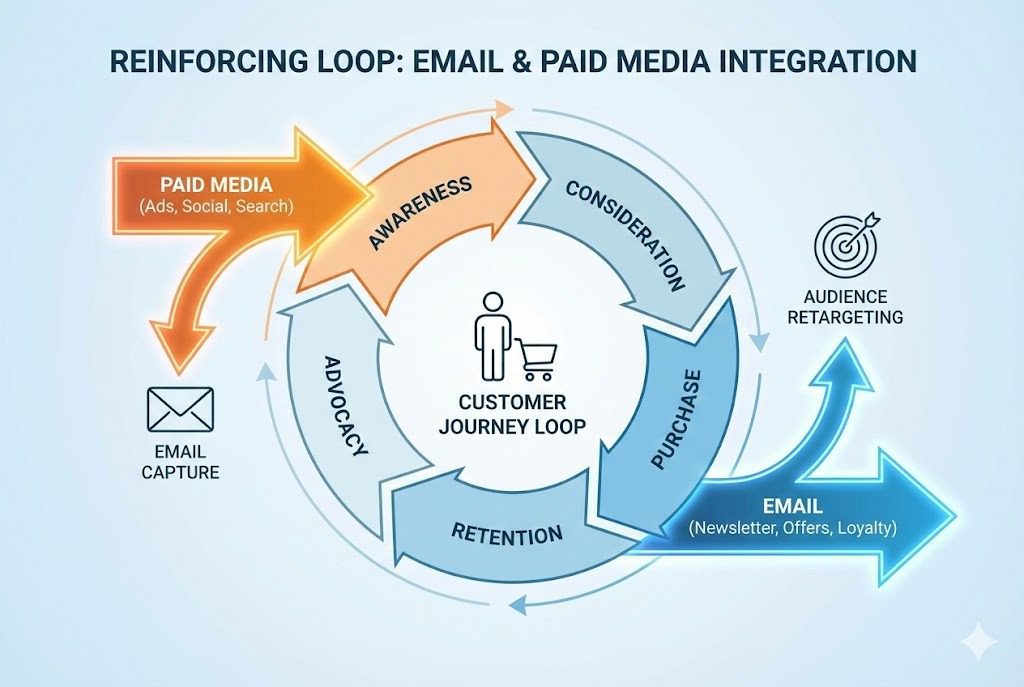
When done right, combining email and paid media unlocks a powerful “cross-channel marketing” engine that delivers better conversion, more revenue, and stronger customer relationships. 

This article shows how to build that engine: what works, what to watch out for, and concrete steps you can take.

By the end, readers will understand how to:

  • Align email and paid-media data for unified audiences
  • Use email remarketing and ads synergy to boost conversion and customer value
  • Build automated, integrated marketing campaigns that scale

Why Email + Paid Media Integration Matters

  • Email remains one of the highest-ROI channels out there. Some studies report that automated emails generate up to 320% more revenue than non-automated ones.
  • Paid media provides instant reach and visibility, ideal for attracting new prospects. But on its own, paid media often requires a constant budget to deliver results. 
  • When you combine them in a cross-channel marketing strategy, you get the best of both: the reach of paid media and the long-term engagement of email. 
  • Cross-channel marketing also helps deliver unified customer experiences, reduce friction, and increase conversions across the funnel.

That synergy is what smart marketers call email and paid media integration, or cross-channel campaigns.

Core Concepts Behind Email + Paid Media Integration

What is Cross-Channel Marketing

Cross-channel marketing means coordinating messaging and data across multiple channels, email, paid ads, website, and sometimes SMS or social, so that every interaction builds on what happened before. 

It differs from multichannel marketing, where channels exist but operate in silos. In cross-channel setups, channels communicate, share data, and deliver unified, personalized experiences. 

What is Email Remarketing

Email remarketing means using email to follow up with people who have already interacted with your brand, visited your site, abandoned a cart, clicked an ad, etc. It’s cheap, effective, and highly targeted. Evidence shows that remarketing emails can dramatically outperform typical conversion rates. 

Combined with paid media, remarketing becomes even more powerful: you can retarget site visitors with ads and also send those who opt in to your list a follow-up email, reinforcing your message in their inbox and increasing the chance of conversion.

How to Build an Integrated Email + Paid Media Strategy

Here’s a clear, step-by-step framework many high-performing marketers follow when building integrated campaigns:

1. Unify Data and Build Audience Segments

  • Use a central data platform or CRM that captures interactions from ads, website visits, email opens/clicks, and more. This ensures you see the full customer journey. Cross-channel analytics is essential for accurate attribution.
  • Segment audiences based on behavior (e.g., page visited, cart abandonment, past buyers), demographics, source (ad click, organic), and engagement level.
  • Define high-value audience segments, prospects who interacted with ads or visited key pages, and sync them across email and ad platforms (lookalike audiences, retargeting, etc.). This boosts efficiency and conversion.

2. Map Customer Journeys and Align Messaging

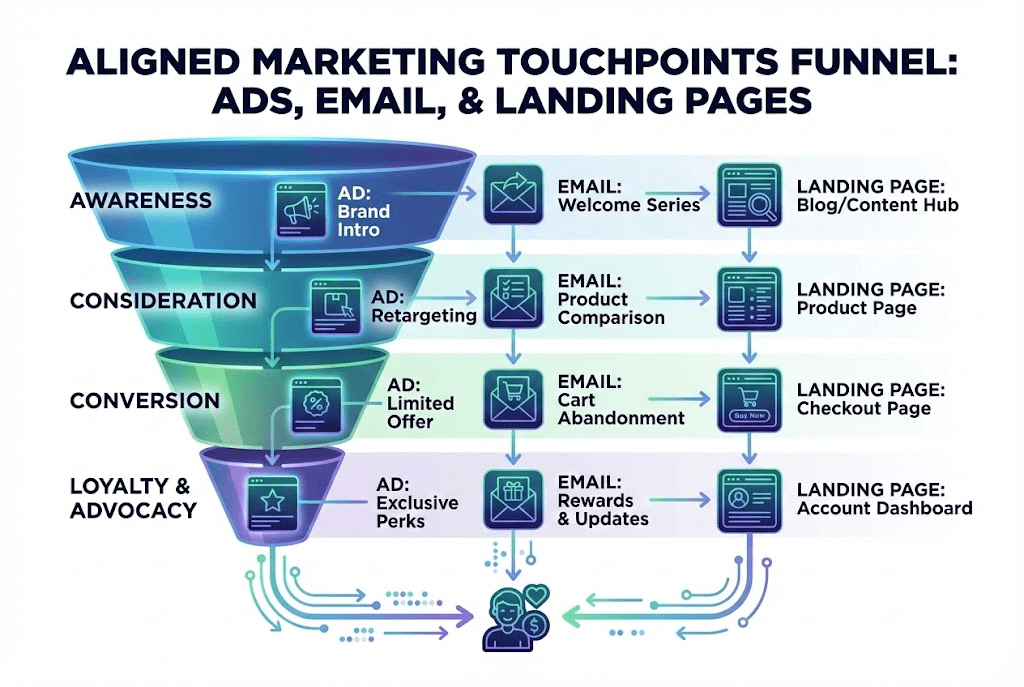
  • Create a “journey map” that outlines how a prospect moves from ad click → website → email or retargeting ad → purchase (or drop off).
  • Design messaging that flows: ad copy should match the landing page content, email follow-ups should reflect the user’s prior behavior, and retargeting ads should echo the email.
  • Use email remarketing for mid-funnel or re-engagement: e.g., send reminder emails to those who abandoned carts, then retarget them with ads to bring them back.

3. Automate the Workflow

  • Build automated workflows that trigger based on behavior: e.g., ad click or page visit → add to email list → send welcome email → if no conversion after X days, trigger retargeting ad or email reminder.
  • Automation ensures timely follow-ups and keeps your messaging consistent without manual effort. This kind of automation-driven email marketing often outperforms manual campaigns.
  • Use tools and platforms that support cross-channel orchestration and unified analytics.

4. Measure Performance with Cross-Channel Analytics

Use cross-channel analytics to track how each channel contributes to conversions. Without it, you risk misattributing success or missing where conversions drop off. 

Track metrics like:

  • Conversion rate per channel and overall funnel conversion
  • Cost per acquisition (CPA) when combining paid media + email vs. paid alone
  • Revenue per user or per segment
  • Engagement metrics (open rate, click-through rate, ad frequency, ad engagement)

This data guides budget allocation and helps refine strategies.

Common Mistakes and How to Avoid Them

MistakeConsequenceHow to Avoid
Siloed channels (ads and email not sharing data)Inconsistent messaging, poor attributionUse unified data platforms or CRM to connect all channels
Generic messagesLower engagement and conversionsSegment audiences and personalize based on behavior
Manual workflows onlySlow, inefficient, inconsistent timingBuild automated workflows triggered by user actions
Ignoring attribution/analyticsHard to know what works or where to investUse cross-channel analytics and multi-touch attribution
Treating email or ads in isolationHigher spend, lower ROICombine channels to amplify strengths and reduce reliance on one

Real-World Example: What This Looks Like in Practice

Imagine a brand launching a new product with both paid ads and email marketing:

  • They run a paid ad campaign to attract new prospects. Anyone who clicks the ad and visits the site gets added to an audience list.
  • Immediately after a site visit or sign-up, the system sends a welcome email introducing the product, perhaps with a small discount or free resource.
  • If the user doesn’t convert in 3 days, the system triggers a retargeting ad highlighting social proof or a case study related to the product, reinforcing the email message.
  • If no conversion after 7 days, send a reminder email with urgency (limited-time offer) + another retargeting ad.
  • Once the user buys, mark them as a customer. Then use a separate email sequence for onboarding or upselling, and exclude them from new acquisition ads.

This coordinated, data-driven flow makes users feel recognized and nudges them toward conversion in a supportive way, not pushy.

Where Most Competitors Fail, And What That Means for You

Most content on “integrated marketing” focuses on theory or surface-level tips. Few offer a real, actionable framework combining data, automation, segmentation, analytics, and cross-channel coordination.

Few also give clear guidance on measuring performance across the funnel, making it hard to know if their integration is working.

This gap gives you an opportunity to build a robust, results-driven email + paid media strategy that outperforms typical siloed campaigns.

Frequently Asked Questions

What metrics should you track when combining email and paid media

You should track conversion rate, cost per acquisition (CPA), revenue per user, engagement metrics (open rate, click-through rate), ad engagement, and cross-channel attribution data. 

Impremis can help set up cross-channel analytics to deliver accurate attribution and show which touchpoints, email, ads, or both, perform best.

How does email remarketing fit into a broader integrated marketing campaign

Email remarketing works best as part of a larger ecosystem. When a user interacts with paid media but doesn’t convert, remarketing emails provide a second chance to engage. 

With a unified data platform and automation, Impremis can build those email flows, segment audiences, and ensure every user receives relevant messaging at the right time.

Can small businesses benefit from an email and paid media strategy, or is it only for enterprise brands

Small businesses often benefit even more. Because email remarketing and automated sequences are cost-effective and scalable, they provide high ROI without requiring massive budgets. 

With proper segmentation and coordinated retargeting campaigns, small brands can compete with bigger players. Impremis’s performance-marketing and email-marketing capabilities make this accessible for any brand.

Next Step: Build Your Own Email + Paid-Media Engine

If you’re ready to turn siloed ads and email into a unified engine that drives ROI, conversions, and long-term growth, let’s get started.

Contact Impremis to discuss how their full suite of services, from performance marketing and email marketing to conversion optimization and web design, can build a cohesive, expertly managed cross-channel campaign for you.

Most brands send emails. Very few send email that feels personal enough to make people click, buy, and come back. The difference is not volume. It is how well they use data, segmentation, and timing to speak to each person like a real human.

This guide walks through how to build personalized email campaigns that convert, step by step, using practical examples and proven benchmarks.

Key takeaways:

  • Personalization can lift opens, clicks, and revenue by big margins.
    Smart segmentation and triggers matter more than fancy designs.
  • A simple framework makes it easy to build and optimize campaigns that actually convert.

Why Personalized Email Campaigns Win

People see dozens of emails every day. Generic blasts fade into the inbox. Personalized messages stand out.

Recent email personalization statistics on engagement and revenue show that tailored emails can improve open rates by around 29%, click-through rates by 41%, and drive much higher revenue than generic sends.

Another recent email personalization ROI benchmark report found that nearly half of U.S. consumers prefer personalized deals, and personalized email can produce a median ROI of well over 100%.

That means personalization is no longer a “nice to have.” It is what customers expect.

[IMAGE: Illustrated inbox showing one generic email and one highly personalized email with higher engagement metrics.]

The Foundations: Data, Segmentation, and Triggers

To build email campaigns that convert, three pieces must work together:

1. Data

  • Demographics (location, age group, job role).
  • Behavior (pages visited, products viewed, emails opened).
  • Purchase history (first-time vs repeat, categories, price levels).

2. Segmentation

  • Group people into meaningful segments, not just “all subscribers.”
  • Use behavior and lifecycle stage to drive different journeys.
  • A modern email segmentation strategy guide with real examples shows how breaking lists into engaged vs unengaged, one-time vs repeat buyers, and recent vs lapsed customers can drive much stronger results.

3. Triggers and automation

  • Welcome series after signup.
  • Abandoned cart flows.
  • Post-purchase follow-ups.
  • Re-engagement for cold subscribers.

When data, segmentation, and triggers align, each person gets emails that match where they are right now, not just where the brand wants them to be.

A Simple Framework for Email Marketing Personalization

To keep personalization practical, think in three steps:

1. Right person
Who is this email for?

  • Segment by lifecycle: new subscriber, first-time buyer, repeat customer, churn risk.
  • Segment by behavior: viewed product, abandoned cart, downloaded a guide, attended a webinar.

2. Right message

What does this person need to see next?

  • New subscriber: clear promise, story, social proof, and next step.
  • Abandoned cart: reminder, urgency, and risk reversal (returns, guarantees).
  • Loyal customer: exclusive perks, early access, referrals, or VIP content.

3. Right time

When should they get it?

An email personalization best practices checklist highlights that timing and frequency are part of personalization too: send when each subscriber is most likely to open and take action.

If they follow this “person, message, time” framework, teams can plan campaigns that feel personal without over-complicating the tech.

Email Segmentation Tips That Make Personalization Work

Segmentation is where most brands either win big or fall flat. A few simple email segmentation tips can produce a large lift in conversions.

Useful segments include:

  • Engagement level
    • Highly engaged (opens and clicks often).
    • Passive (opens sometimes, rarely clicks).
    • Cold (no opens in 60–90 days).
  • Customer value
    • High spenders vs discount-driven buyers.
    • One-time buyers vs loyal repeat buyers.
  • Lifecycle stage
    • New leads, active customers, and lapsed customers.
  • Category interest
    • Interests or product categories based on browsing and purchase history.

A recent email segmentation strategy breakdown with practical examples shows that even simple segments like “new customers,” “VIPs,” and “at-risk customers” can produce outsized results when each group receives dedicated messaging.

They do not need 50 segments to win. They need a handful of high-impact segments with clear goals.

Quick segmentation table

Segment TypeExample RuleGoal
New subscriberJoined list in last 7 daysWelcome, educate, activate
Abandoned cartAdded item but no purchase in 24 hoursRecover lost revenue
VIP customer3+ orders or high lifetime valueRetain, reward, upsell
At-risk customerNo opens or purchases in 90 daysRe-engage or sunset gracefully

Personalization Tactics That Go Beyond First Name

Using a first name is entry-level personalization. The real gains show up when emails adjust to behavior, context, and intent.

High-impact tactics include:

  • Dynamic content blocks

Show different products or content based on browsing history or category interest. A recent email personalization guide focusing on dynamic content and relevance explains how tailoring on-site behavior to inbox content boosts engagement.

  • Location-aware content

Use city or region to tailor events, shipping info, or store locations.

  • Personalized send time

Send based on each subscriber’s open patterns, not a generic blast time.

  • Behavior-based offers
    • Higher incentive for cold segments to come back.
    • Lower or no discount for engaged, high-value segments.
  • Content based on role or use case

For B2B, tailor emails to decision-makers vs hands-on users with different pain points and value props.

The goal is simple: every email answer the question, “Why is this for me, right now?”

Personalized Email Marketing Examples in Action

Here are a few simple scenarios to show personalization at work without needing a huge team:

  1. Welcome series that adapts by intent
    • A subscriber who joined from a pricing page gets more proof, FAQs, and case studies.
    • A subscriber who came from a blog post gets more education, frameworks, and “how-to” content.
  2. Abandoned cart with personalized objection handling
    • If the cart total is high, emphasize guarantees and payment options.
    • If the user abandoned multiple times, highlight urgency and social proof.
  3. Post-purchase flow tailored to product type
    • For consumables: education on how to use, plus timed replenishment reminders.
    • For software or services: onboarding tips, quick wins, and “first success” milestones.
  4. Re-engagement based on past behavior
    • Content-driven subscribers get “best of” or recap content.
    • Deal-driven subscribers receive time-bound offers or loyalty points.

Brands that apply even two or three of these flows often see big jumps in email-driven revenue compared to one-off campaign blasts.

How to Measure Conversion in Personalized Email Campaigns

Personalized email campaigns that convert are built on data and optimized over time.

Key metrics to track:

  • Open rate
    • Are subject lines and send times working for each segment?
    • Some recent email marketing benchmark reports show open rates in North America often landing around the mid-40% range for well-run campaigns.
  • Click-through rate (CTR)
    • Do people take action after opening?
    • Industry research on email marketing CTR benchmarks suggests that a “good” CTR often falls around 2–5%, depending on industry and list quality.
  • Conversion rate
    • How many subscribers complete the target action: purchase, demo, call, or signup?
  • Revenue per send / per subscriber
    • The cleanest way to see if personalization is actually making more money.

This is where a partner like Impremis’ email marketing and automation specialists can help connect email strategy with on-site UX and conversion rate optimization so every click has a better chance of turning into revenue.

How many personalization elements should an email include?


Too much personalization can feel creepy or confusing. Most high-performing campaigns focus on a few high-value elements, such as segment-specific content, dynamic product blocks, and timing based on behavior. 

Teams that work with Impremis can audit existing flows and prioritize personalization tactics that improve UX and clarity instead of adding noise, which supports stronger conversion rates and better on-site performance.

Does personalization work for small email lists?


Yes. In fact, smaller lists often benefit more, because every subscriber is more valuable. Even simple segmentation by engagement level or recent activity can lift conversions. 

Impremis helps smaller teams design lean email systems, connect them to clean landing pages, and apply conversion rate optimization so each visitor has a smoother path from inbox to action.

How often should personalized emails be sent?

Frequency depends on audience, industry, and value of each message. 

A good rule is to start with triggered flows like welcomes, abandoned carts, and post-purchase journeys, then layer in consistent but not overwhelming campaigns. 

Impremis typically reviews performance data, web analytics, and UX friction points to recommend send frequency that keeps revenue high while protecting unsubscribe and spam complaint rates.

Turn Personalization Into a Revenue Channel

Personalized email campaigns are not just about using a first name. They are about sending the right message, to the right person, at the right time, and then backing it up with a smooth on-site experience.

If they want help planning segmentation, building automated flows, and aligning email with their website and funnel, they can partner with a team that does this every day.

Learn more about how Impremis helps brands grow with full-funnel strategy or reach out through the contact page to start mapping out personalized email campaigns that actually convert.

In a noisy digital world, grabbing attention and making your message stick isn’t easy. That’s why visual storytelling marketing works so well. By weaving emotional, image-driven narratives into ads, brands can cut through the clutter, connect with audiences fast, and drive stronger results.

This article explains how to use storytelling in advertising to improve ad performance with visuals. You’ll learn practical tactics plus real examples and leave with action steps you can apply right away.

Key takeaways:

  • Visuals plus narrative engage faster and improve recall
  • Branding, color, composition, and consistency make visual stories stronger
  • You can use video, images, infographics, or motion to boost engagement

Why Visual Storytelling Marketing Works (Better Than Words Alone)

People process visuals much faster and remember them better than text. Using imagery, graphics, or video helps brands communicate complex ideas quickly and create emotional resonance.

  • Content with relevant images gets far more engagement compared to text-only content.
  • Visual storytelling establishes an emotional connection. That emotional bond makes messages more memorable and drives action.

Effective visual stories don’t just show a product; they show a benefit, an experience, or a feeling that resonates with the audience.

Core Elements of Effective Storytelling in Advertising

Visual + Narrative = Story

A strong visual story isn’t just a pretty picture. It pairs a compelling image (or video) with a meaningful narrative. Think of a beginning, middle, and end, painting a context, revealing a problem or need, and delivering a resolution or value. This is especially powerful in video ads. 

Use Color, Composition, Context, Consistency

Successful visual storytelling often uses a consistent style: brand colors, composition, tone, and context. This visual consistency reinforces brand identity and makes campaigns instantly recognizable. 

Color choices also evoke emotion. For example, warm colors can feel energetic or urgent; cool colors can feel calm or trustworthy. 

Leverage Visual Metaphors

Visual metaphors use familiar symbols or scenes to represent ideas, often more powerfully than literal images. For instance, showing a lightbulb for a new idea, a sunrise for hope, or a path for a journey. These metaphors trigger instant understanding and emotional response. 

Craft Emotion and Human Connection

Ads that evoke feelings, empathy, joy, urgency, and belonging perform better. Storytelling turns brands into humans by spotlighting real people, struggles, or aspirations. Emotional resonance builds trust, loyalty, and motivation to act.

Visual Storytelling Formats That Boost Ad Performance

Different formats suit different goals and audiences. Here are some of the most effective:

FormatBest Use CaseWhy It Boosts Engagement
Short video adsProduct demos, brand stories, emotional appealsVideo combines motion, music, visuals → grabs attention fast, conveys mood and narrative efficiently. Many marketers report high recall for video ads. 
Static image ads/hero imagesSimple value propositions, promotions,and  brand identityStill visuals + minimal text → clear message, easier to process, ideal for quick impression. Visuals are processed faster than text. 
Infographics/datavisualsEducating, explaining benefits, comparison, B2B, or complex productsBreak down complicated info into digestible visuals, increasing understanding & retention. 
Carousel/slideseries (social ads or landing pages)Story arcs, before/after, problem → solution journeysAllows building a narrative over multiple frames, great for storytelling. Many successful campaigns use this across social and web. 

Real Visual Storytelling Marketing Examples

Brands across industries use visual storytelling to boost engagement and conversions. A few standouts:

  • A campaign that followed a real family’s experience, combining interviews and B-roll footage to tell a meaningful story, a powerful emotional connection, and brand trust.
    Video-driven storytelling campaigns using narrative arcs (problem → struggle → resolution) to make the brand part of the user’s journey. 
  • Use of visual metaphors: replacing literal product imagery with symbolic visuals to evoke ideas, values, or benefits, often leaving a stronger impact. 

These examples show that effective storytelling doesn’t require a massive budget. What matters is logic + emotion + clarity.

How to Use Storytelling in Ads: A Step-by-Step Guide

  1. Define the core brand story or message
    Clarify what your brand stands for, what problem you solve, and how you help your audience. That becomes the foundation.
  2. Know your audience deeply.y
    Understand their needs, pain points, and aspirations. Create visuals and narratives that resonate with their worldview.
  3. Choose the right visual format for your message
    Is this a quick emotional hook (video/image)? Or a deeper explanation (infographic/carousel)?
  4. Design with consistency
    Use brand colors, fonts, and style across all visuals; this builds recognition and trust.
  5. Use visual metaphors or human stories
    Let visuals do the heavy lifting. Use symbolic images or show real people’s stories or transformations.
  6. Optimize for platforms and ad viewability
    Ensure ads display well on mobile, social, and web. Make sure visuals are clear even without sound (for silent autoplay), and text overlay is readable.
  7. Measure performance, engagement, recall, conversions
    Track metrics like click-through, view rate, conversion, and engagement rate to see what works.
  8. Iterate and refresh visuals to avoid ad fatigue
    Over time, audiences get used to repeated visuals. Refresh creative or story angle for sustained performance. (This aligns with the principle behind ad variation). 

Common Mistakes to Avoid When Using Visual Storytelling

  • Overcrowding visuals with too many elements dilutes message clarity.
  • Using generic or stock photos that don’t connect emotionally, authenticity matters.
  • Ignoring brand style and consistency across ads, inconsistent visuals weaken brand recall.
  • Skipping narrative structure: visuals without a story lead to forgettable ads.
  • Not adapting visuals to the platform, a design that works on desktop might fail on mobile.

FAQ

What types of visuals work best for storytelling in ads?


Visuals that combine emotional appeal and relevance work best, such as photos or videos showing real people, scenes, results, or aspirational states. Infographics and data-driven visuals also work well if the goal is to explain a benefit or demonstrate value.

At Impremis, we lean on visual storytelling combined with solid web design and UX to deliver ads that convert, not just look good.

How does visual storytelling help improve conversion rates, not only engagement?


Because visual storytelling makes messages more memorable and emotionally resonant, viewers are more likely to respond, click, sign up, or buy. Visuals help simplify complex ideas and build trust, increasing the chances of conversion.

That aligns with the conversion-rate optimization principles that Impremis applies in its performance-marketing and web-design services.

Can small businesses use visual storytelling effectively without a big production budget?


Yes. You don’t always need big budgets. Simple, authentic visuals, user photos, minimalist graphics, or even an illustrated metaphor can communicate a powerful story. With consistent brand style and smart narrative, even small-scale visuals can outperform generic ads.

Impremis often works with brands to create compelling storytelling visuals on modest budgets and still delivers strong results.

Ready to Elevate Your Ads with Visual Storytelling?

If you want to turn your brand story into ads that engage, convert, and build loyalty, reach out to the team behind this article. Whether you need expert web design, creative visuals, or a data-driven ad strategy, Impremis is ready to help. 

Visit our main page to explore our full capabilities or contact us here for a tailored plan.

Shopping cart0
There are no products in the cart!
0