

Close Menu

Most brands run email and paid media on separate tracks, but the companies that grow fastest understand that these two channels perform far better when they support each other. 

When email and ads work together, brands see higher engagement, stronger conversions, and lower acquisition costs. 

This guide breaks down exactly how to align email and paid media for maximum impact using simple, proven steps.

Key takeaways:

  • Email and paid media perform significantly better when messaging, timing, and audiences are aligned.
  • Coordinated campaigns build recognition and reduce friction, boosting conversions across channels.
  • A clear framework makes cross-channel marketing easier to implement at any scale.

Why Email–Paid Media Alignment Matters

Email remains one of the highest-ROI marketing channels, and paid media gives brands fast reach and targeting. When they operate together, they reinforce each other’s strengths.

Research from Statista’s digital marketing effectiveness benchmarks shows that consumers often need multiple touchpoints before they convert. Email and ads working together create those touchpoints consistently.

Meanwhile, cross-channel coordination is highlighted in the Adobe Experience Cloud cross-channel personalization guide as a key driver of customer engagement and retention.

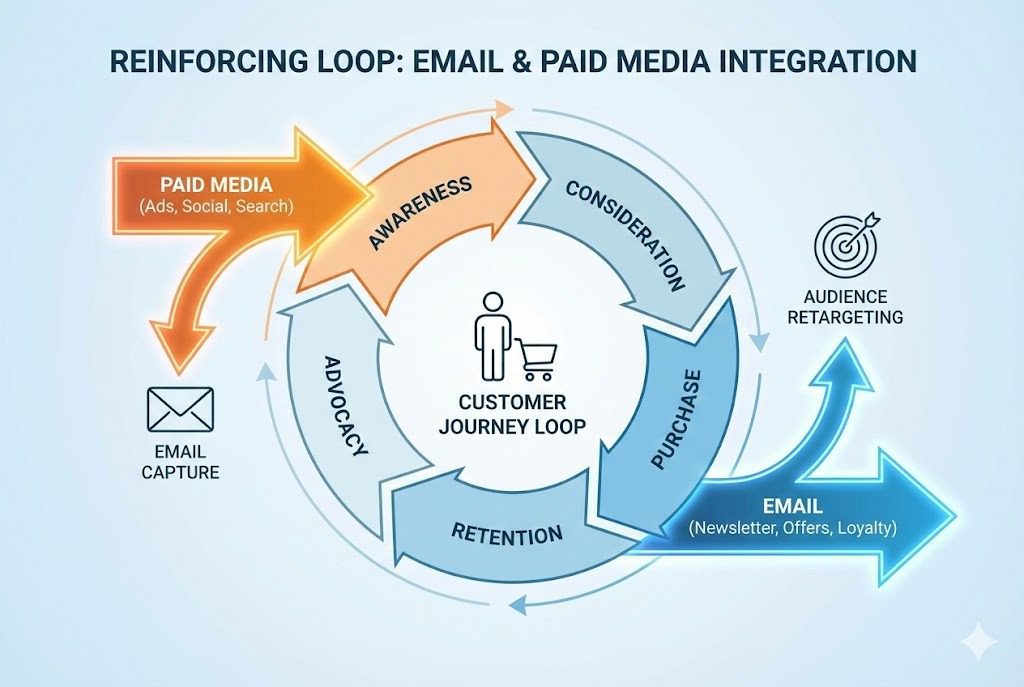
Together, email and paid media form a loop: ads bring people in, email nurtures them, and retargeting campaigns bring them back until they purchase.
How Email Enhances Paid Media Performance

Email supports paid media in several ways:

Builds trust faster

People who already received helpful emails recognize your brand instantly in ads. This increases click-through rates and lowers customer hesitation.

Improves ad relevance

Your email engagement data, opens, clicks, product interest, can inform your paid audiences. This ensures ads match what subscribers already care about.

Reduces acquisition costs

Warm audiences cost less to advertise to. When you sync email lists into ad platforms, your cost per click and cost per acquisition drop.

Supports full-funnel nurturing

Paid ads generate attention, but email closes the gap with reminders, education, and offers that speed up the buying process.

How Paid Media Improves Email Marketing

Paid media also strengthens email performance:

Grows high-quality subscribers

Well-targeted ads bring in better leads. When new subscribers join through clear, well-positioned offers, your open and click rates rise.

Re-engages inactive email contacts

Paid remarketing keeps your brand visible even when subscribers stop opening emails.

Creates consistent messaging across channels

By syncing your campaign themes, your ads and emails reinforce the same story, making your brand more memorable and trusted.

Supports product launches and big promotions

Paid campaigns help build momentum, and email captures the conversion.

A Framework for Aligning Email and Paid Media

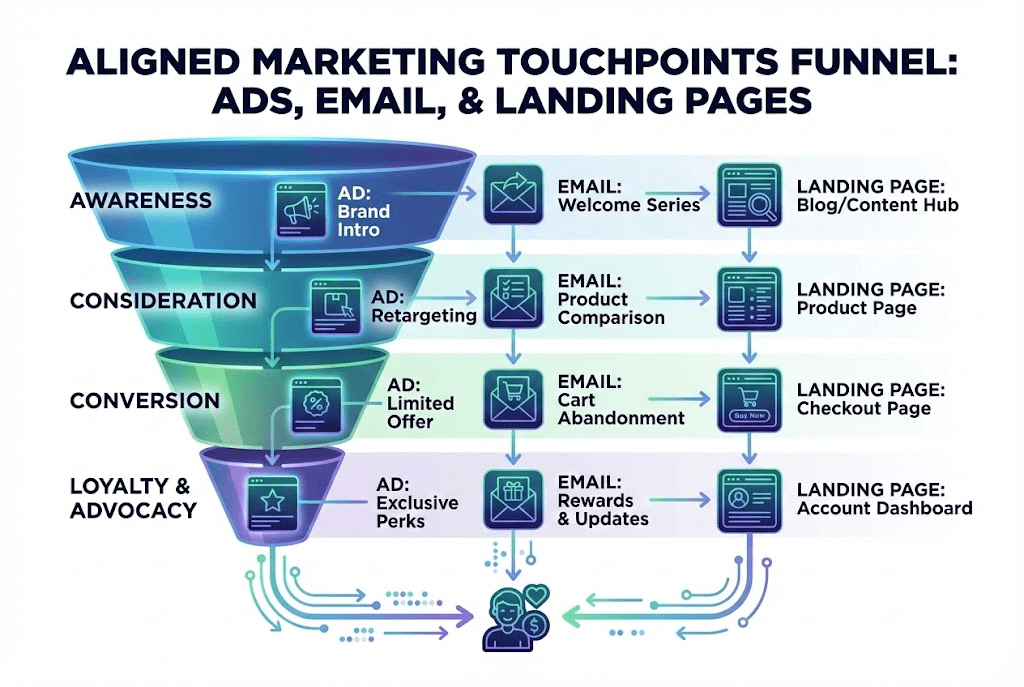
The most effective brands use a simple alignment system built on five steps:

StepWhat to DoWhy It Matters
1. Sync audiences and lifecycle stagesImport email segments into ad platforms for warm retargetingMakes ads cheaper and more relevant
2. Match messaging and offersEnsure ads and emails share consistent tone, visuals, and promisesReinforces brand trust across channels
3. Align timingPlan campaign timelines so ads and emails support each otherPrevents channel conflicts and confusion
4. Use cross-channel trackingTrack touchpoints across email, site visits, and ad impressionsReveals which combinations produce the best ROI
5. Optimize based on shared dataUse paid data to refine emails and email data to refine adsImproves both channels over time

This structure ensures every message feels intentional and seamless, not scattered or contradictory.

Email and Paid Media Alignment Examples

Coordinated product launch

  • Ads build awareness and excitement.
    Email delivers deeper product details and early access.
  • Retargeting ads follow subscribers who visited the site but didn’t convert.

Cart abandonment sequence

  • Paid retargeting shows reminders or social proof.
  • Email provides deeper reassurance (returns, FAQs, testimonials).

Together, they lift cart recovery significantly.

Re-engagement flow

  • Email attempts to win back inactive subscribers.
  • Paid remarketing touches users who no longer open emails.

Both channels reinforce brand visibility until a subscriber comes back.

Lead-nurture drip

  • Ads reintroduce the brand after key interactions.
  • Email shares more educational content that drives trust.

This accelerates the sales cycle without relying on email alone.
Tools That Help Sync Email and Ads

Modern ad platforms and email systems make cross-channel alignment easier than ever. Here are the most helpful tools:

  • Customer match + audience uploads found in the Google Ads audience integration documentation help brands target subscribers with precision.
  • Behavior-driven segmentation through email platforms ties user actions to ad audiences.
  • Cross-channel personalization frameworks, outlined in the Adobe Experience Cloud personalization overview, help unify messaging at scale.
  • Attribution and performance dashboards tie email clicks, ad impressions, and on-site behavior together.

These tools create better alignment while reducing manual work.

Common Mistakes That Hurt Email–Paid Media Performance

Many brands unknowingly lose performance due to misalignment. The biggest mistakes include:

  • Running ads with one message and sending emails with another.
  • Using different visuals or tone across channels.
  • Not syncing email lists into ad platforms for lower-cost retargeting.
  • Running email campaigns without supporting paid ads during key moments.
  • Failing to track both channels together, leading to poor decision-making.

Avoiding these mistakes keeps campaigns clean, unified, and more profitable.

Action Steps to Align Your Next Campaign

A few simple steps can transform your results:

  • Audit your email sequences and paid ads for message consistency.
  • Sync your email list into paid platforms for warmer retargeting.
  • Plan campaign calendars where email and ads support each phase.
  • Use cross-channel tracking to measure how ads and emails interact.
  • Review landing pages to ensure they match both ad and email promises.

This is also where a partner like Impremis can help, blending email strategy, paid media structure, UX, and conversion optimization into a cohesive system.

Frequently Asked Questions

How do you tell if email and paid media are aligned?

Look for message consistency, shared timing, and unified targeting. If one channel says something different than the other, friction appears. Impremis helps brands build unified messaging frameworks so ads and emails reinforce the same story and conversion path.

Is cross-channel alignment too complex for small teams?

Not when approached with a clear structure. Even small teams can align audiences, visuals, and messaging. Impremis often guides smaller brands through simple alignment systems that improve conversions without increasing workload.

Does cross-channel alignment improve conversion rates?

Yes. When email and ads work together, users feel more confident and move through the buying journey faster. Impremis enhances this by ensuring the landing experience, UX, and content match what the ads and emails promise.

Turn Your Email + Paid Media Into a Unified Growth System

If you want stronger conversions, lower costs, and a cleaner customer journey, aligning email and paid media is one of the fastest ways to get results. Impremis helps businesses connect campaigns, optimize messaging, and build high-performing cross-channel systems.

Explore strategy and capabilities at Impremis or connect with the team through the contact page to start building integrated campaigns that drive measurable growth.

In today’s fast-moving marketing world, waiting days or weeks to see if ads worked feels slow. 

A live marketing dashboard gives instant clarity, showing in real time whether ads, email, or other channels are generating returns. 

When properly set up, a live ad performance dashboard delivers clarity, speed, and smarter decisions. Key takeaways:

  • Live dashboards unify data from all channels, so teams see true ROI across marketing efforts.
  • Real-time ROI tracking enables fast budget shifts, stops wasted ad spend, and maximizes profitable campaigns.
  • Marketing analytics dashboards make it easier to align paid media, email, web, and analytics under one view.

What Is a Live Marketing Dashboard

A live marketing dashboard is a centralized, interactive interface that pulls in data from multiple marketing channels, paid ads, web analytics, email platforms, and more, and displays key performance indicators (KPIs) in real time.

Unlike static reports that show performance after the fact, a live dashboard offers an up-to-the-minute snapshot. 

This means marketers don’t need to dig through spreadsheets or toggle between tools. Everything lives in one place: impressions, clicks, conversions, spend, and ROI metrics like ROAS or CAC. 

Why Real-Time ROI Tracking Matters

Many organizations struggle with delayed reporting, data silos, and fragmented metrics. Real-time ROI tracking solves these pain points:

  • Faster, smarter decisions. Real-time feedback lets teams pause underperforming ads or scale winners immediately. 
  • Better budget allocation. By comparing ROAS, cost-per-acquisition (CPA), or lifetime value (LTV) across channels, ads, email, and web, marketers can reallocate spend dynamically for maximum return. 
  • Clear performance visibility. Live dashboards break down marketing silos and provide a unified view. 
  • Reduced manual reporting load. Teams save hours every week previously spent compiling data.

Studies show companies using centralized, real-time dashboards often see faster decision-making and significant ROI improvements compared with those using traditional reporting.

Essential Metrics to Track on Your Dashboard

To make a dashboard meaningful, include the metrics that show real performance. Most marketing analytics dashboards use at least the following: 

Metric TypeWhy It Matters
Cost per Acquisition (CPA)Shows how much you spend to gain a customer; helps control budget waste.
Return on Ad Spend (ROAS) / ROIIndicates return relative to investment, across ads and channels.
Conversion Rate & Funnel ConversionMeasures the effectiveness of landing pages, ads, email flows, etc.
Customer Lifetime Value (CLV / LTV)Helps assess the long-term value of customers, not just the initial sale.
Engagement metrics (clicks, opens, sessions)Provides early signs of interest or drop-off before final sale.
Channel-level spend and revenueAllows cross-channel comparisons to identify the highest ROI sources.

Visualizations like line charts, bar graphs, funnel views, and scorecards make data easy to scan.

How to Build and Use an Effective Live Dashboard

Step 1: Define Goals and KPIs

Start with business goals: lead generation, sales growth, and customer acquisition. Then identify KPIs tied to those goals: CPA, ROAS, conversion rate, LTV, etc.

Focus only on metrics that drive decisions. Avoid “vanity metrics” that don’t impact ROI. 

Step 2: Integrate All Data Sources

Connect advertising platforms, web analytics, email systems, and CRM, ideally through APIs or connectors, so the dashboard flows data automatically.

Use a unified data backbone or data platform (similar to a data management platform, or DMP) to handle data collection, cleaning, and unification. 

Step 3: Build Visualizations & Role-Based Views

Set up dashboard views for different roles. Executives may want high-level ROAS and revenue, while media buyers or performance marketers need granular ad-level CPA, conversion rate, etc. 

Design the dashboard for clarity: avoid clutter, highlight actionable KPIs, and ensure real-time updates. Simplicity drives faster decisions.

Step 4: Monitor, Analyze, React

Watch your dashboard daily (or more often) to spot performance dips, overspending, or underperforming ads. Use alerts for major KPI shifts. Real-time visibility helps you pivot quickly. 

Use insights to reallocate budget, stop poor performers, adjust targeting, or optimize landing pages and ad copy.

Common Challenges and How to Overcome Them

  • Data silos and integration issues. Many businesses struggle to combine data from multiple platforms into one unified source. Use a robust data platform or tools designed to aggregate and standardize data.
  • Overwhelming dashboards. Too many metrics or poorly organized dashboards create confusion. Keep dashboards simple with only essential KPIs and clean visuals.
  • Slow or outdated data. If data isn’t updated in real time, you lose the main advantage. Ensure your data connections refresh frequently.
  • Lack of skills or buy-in. Teams may need training to interpret data or act on it. Foster a data-driven culture and assign ownership.

Example of Real-Time Dashboard in Action

Imagine a performance marketer running a combined email + paid media campaign. With a live marketing analytics dashboard:

  • They see ad spend, conversions, email opens, and revenue from both channels in one view.
  • Midway, they notice the paid ads have high spend but low conversions, but the email channel is converting well.
  • The marketer shifts budget away from the poor-performing ads and increases spend on email-based retargeting in real time.
  • Within hours, they see improved conversion rate and lower CPA.

That immediate reaction would be impossible with delayed reporting.

What to Look for When Choosing a Paid Media Reporting Tool

When evaluating advertising dashboards or ROI tracking software as part of your marketing stack, make sure the tool:

  • Aggregates data from all major ad platforms, CRM, web analytics, and email systems (unified data integration).
  • Supports real-time or near–real-time updates (not daily or weekly snapshots).
  • Lets you build custom KPIs (ROAS, LTV, conversion rate) relevant to your business goals.
  • Offers role-based dashboard views and simple, clear visualizations.
  • Allows alerts or anomaly detection so you get notified when metrics move sharply.

Many modern marketing analytics dashboards offer exactly these features. 

Why This Gives You an Advantage Over Most Competitors

Most businesses still rely on static reports or manual spreadsheets. They see performance with a delay, then respond too late.

By contrast, a real-time ad performance dashboard gives you speed, clarity, and control. It turns guesswork into data-driven action. It lets you catch problems early, scale winners fast, and allocate budget more intelligently.

That’s the kind of advantage a sophisticated cross-channel marketing integration, like the ones delivered through the performance-marketing services at Impremis, creates.

Frequently Asked Questions

How often should a live dashboard update be effective

Ideally, the dashboard updates continuously or at least every few hours. Real-time or near real-time updates ensure you see performance shifts quickly. Using Impremis’s expertise, teams can set up automated data pipelines and ensure fresh data flows without manual input, reducing lag and enabling rapid decisions.

Can small or mid-size businesses benefit from real-time ROI tracking dashboards

Yes. Even smaller businesses often run mixed campaigns, paid ads, email, and web, and need to know what actually drives conversions. With the right tools, Impremis can implement a marketing analytics dashboard tailored to its budget and scale. This gives them enterprise-level reporting and insights without big overhead.

What if data sources are in silos? Can a dashboard still work

Yes, but only after data integration. Silos prevent full visibility. That’s why integrating ad platforms, web analytics, CRM, email, etc., into a unified data backbone in a data-management platform (or similar architecture) matters.  Impremis specializes in setting up these integrations so dashboards reflect accurate, complete data across channels.

Take Action, Start Tracking ROI in Real Time

If you’re ready to stop chasing spreadsheets and guesswork and want a real-time, unified view of your marketing performance, explore how Impremis’ performance-marketing, analytics infrastructure, and cross-channel integration services can transform your tracking.

Visit the Impremis or reach out via the contact page to get started.

In a crowded marketplace, brands that present a unified identity across ads, social, email, website, and more perform better. Consistent branding builds trust, boosts recognition, and makes people more likely to click, engage, and convert. 

This article explores why multi-platform branding matters, how it impacts ad performance, and what to do to keep your brand consistent across platforms.

Key takeaways:

  • Consistent branding across channels strengthens brand recall, trust, and ad performance.
  • Unified visual and verbal identity drives better returns on ad spend and lowers wasted media costs.
  • A practical, step-by-step branding framework makes consistent execution manageable and scalable.

What Is Brand Consistency, And Why Advertisers Care

Brand consistency means presenting the same visual style, messaging, tone, and identity across every channel, social ads, emails, landing pages, website, and offline materials.

When branding stays consistent, audiences recognize the brand immediately, no matter the touchpoint. That familiarity builds trust and reduces friction when people decide to engage or buy.

For advertisers, consistency matters because each ad impression reinforces the same identity. Over time, that repeated familiarity significantly increases the effectiveness of every campaign.

How Consistent Branding Impacts Ad Performance

Consistent branding delivers measurable benefits when integrated into cross-channel advertising and marketing. Here’s how:

Clearer Recognition and Faster Recall

When colors, logos, tone, and messaging stay the same across platforms, people instantly identify your brand. Studies show that a consistent visual identity can significantly increase brand recognition.

That instant recognition reduces hesitation; your ad feels familiar rather than suspicious. Familiarity builds trust, which improves click-through and conversion rates.

Higher Trust and Professionalism

Inconsistent branding can confuse audiences. Mixed visuals or tone make a brand look disorganized or unprofessional.

On the other hand, consistent branding signals reliability. Consumers are more likely to trust a brand whose visuals and voice match their experience across platforms.

Better ROI: Less Waste, More Impact

Because consistent branding builds recognition and trust, ads become more efficient. Research indicates brands with consistent presentation benefit from higher marketing ROI and lower media waste.

Consistent branding helps reuse assets; you don’t need to rebuild creative for each platform. That saves time, lowers production cost, and speeds up campaign deployment.

Stronger Customer Experience Across Touchpoints

Customers often interact with a brand multiple times before buying, through an ad, a social post, a website, or maybe an email. If each touch looks or sounds different, it fragments the experience. Consistent branding ties them all together, making the journey feel seamless and trustworthy.

That smooth experience reduces friction and increases the likelihood of conversion across platforms, not just from a single ad channel.

Common Gaps Brands Overlook, and How They Hurt Ads

Even experienced marketers sometimes slip up in consistency, especially when campaigns span many channels. Common mistakes include:

  • Using different logos, color palettes, or fonts across ads, website, email, and social media, which muddies the brand image.
  • Shifting tone or messaging depending on campaign or channel, e.g, serious on web, playful on social, leading to mixed signals.
  • Creating new creatives for each platform instead of reusing a unified template increases time and cost, and dilutes identity.
  • Failing to maintain brand guidelines internally, leading to inconsistent execution across teams and channels.

These gaps don’t just hurt brand identity; they reduce ad trust, lower click/conversion rates, and increase cost per acquisition over time.

A Simple Framework to Build and Keep Consistent Branding

Here’s a practical framework advertisers and marketers can use to ensure consistency across all platforms and ads:

StepWhat to DoExpected Benefit
Define core brand identityEstablish logo, color palette, typography, tone of voice, messaging pillarsCreates a single source of truth for all creatives
Build brand guidelinesDocument visual rules, tone, use-cases, and messaging standardsEnsures consistency across teams and channels
Use reusable templatesDesign ads, landing pages, and emails using on-brand templatesSaves time and preserves brand identity across campaigns
Audit channels regularlyReview website, ads, social posts, email, and display creatives for alignmentDetect and correct drift before it impacts results
Maintain unified messaging across platformsEnsure ad copy, landing pages, email content, and social posts reflect the same values and promisesBuilds trust and long-term recognition
Measure performance and feedback loopsTrack ad performance, conversions, brand recall, and user feedbackValidate that consistency improves results and refine as needed

This framework works whether you manage a small startup or a multi-channel enterprise, and it helps keep ad campaigns aligned for maximum impact and efficiency.

Real-World Examples of Effective Brand Consistency

  • A business running social ads, search ads, email marketing, and organic content uses the same logo, color palette, and tone. The result: each conversion path, from ad click to email nurture to purchase, feels seamless.
  • A brand launches a new product and uses unified identity across paid media, organic social, and landing pages, boosting recall and making ads more trusted among returning visitors.
  • A company maintains a style guide that all teams (ads, web development, copywriting, design) follow. Over time, their cost per acquisition decreases because users recognize and respond to their ads more readily than competitors with disjointed branding.

In each case, consistent branding works as an invisible converter, reducing resistance, building familiarity, increasing conversions, and improving ROI.

Frequently Asked Questions

How soon can a business expect to see better ad results after standardizing branding?

Improvement varies, but many companies report increases in click-through and conversion rates, and in ad efficiency, within the first few campaign cycles after aligning brand visuals and messaging. Working with a team like Impremis ensures that brand identity, ad creatives, and landing page UX all align, accelerating trust and results.

Is brand consistency more important for large brands or small businesses too?

It matters for both. Small businesses benefit from consistency because it helps build brand recognition faster and builds trust among new audiences. Large brands benefit because consistency helps scale ads across many channels while maintaining credibility. Impremis helps regardless of scale, aligning identity, design, and marketing strategy to optimize performance.

Can brand consistency alone guarantee ad success?

Not by itself. Consistent branding improves trust and recognition and reduces wasted spend, but success also depends on offer quality, targeting, ad creative, user experience, and conversion pathways. Pairing consistent branding with strong UX and conversion-rate optimization delivers the full performance boost.

Ready to Amplify Your Ad Performance With Consistent Branding?

If you’re ready to improve ad results, build trust, and scale across multiple channels, a unified brand identity is your foundation. Impremis can help design and implement brand guidelines, build cohesive creatives, and integrate marketing and ad strategies across web, email, and paid media.

Explore how Impremis can elevate your cross-channel marketing or reach out to start a conversation today.

Visit our home page at Impremis or connect with our team via the contact page.

Remarketing (also known as retargeting) is one of the most powerful paid media tactics to recover lost visitors and turn them into paying customers. When done right, it reconnects with people who browsed your site but didn’t convert. 

This article shows proven remarketing strategies and retargeting ads best practices that increase conversions and maximize ad spend. 

Readers will walk away with actionable steps to launch or improve paid media remarketing campaigns and real-world retargeting campaign tips.

Key takeaways:

  • Understand the difference between remarketing and retargeting, and when to use each.
  • Learn how segmentation, dynamic ads, and frequency control boost effectiveness.
  • See how multi-channel integration and personalization improve conversion rates.

What is remarketing and why does it matter

Remarketing is a digital marketing strategy that re-engages visitors who have previously interacted with your website, app, or content but left without converting. 

Retargeting is a subset of that, delivering ads (on social, display, search, or video) to people who visited certain pages or took specific actions.

Because these audiences are already familiar with your brand, they tend to convert at much higher rates. According to recent data:

Given that the majority of site visitors never return on their own, some studies say nearly 97%, remarketing gives brands a second chance to win these visitors back. 

Core Retargeting Ads Best Practices

Define clear objectives and segment audiences

Before launching any paid media remarketing campaign, the advertiser must set specific goals. Typical goals include recovering abandoned carts, nurturing leads, driving repeat purchases, or boosting brand awareness.

Once objectives are clear, segment your audience based on behavior or engagement level. Common segments include:

  • Visitors who browsed product or service pages
  • Cart abandoners
  • Past customers (for upsells or cross-sells)
  • Users who spent a certain time on the site or visited key pages

This helps tailor your message and bidding strategy to match the intent of each group. 

Use Dynamic Ads and Personalized Creatives

Generic ads often fail with warm audiences; personalization wins. Dynamic remarketing shows users the exact products or services they viewed, making the ad relevant and increasing the likelihood of conversion.

When building ad creatives for remarketing:

  • Mirror the product or page the user previously viewed.
  • Use urgency or incentive (“Limited time offer,” “10% off”).
  • Refresh visuals and copy regularly to avoid ad fatigue.
  • Tailor CTAs to the user’s stage (e.g., “Complete your purchase,” “Continue reading,” “Book a demo”).

Combine Multiple Channels for Maximum Reach

Relying on just one channel limits your reach; multi-channel remarketing boosts results. Common channels include:

  • Display networks (e.g., Google Display Network)
  • Social media (e.g., Facebook, Instagram)
  • Search remarketing (when previous visitors search again)
  • Video (YouTube)
  • Email remarketing (e.g., cart abandoners, past customers)

Using multiple touchpoints increases brand recall and conversions. One report found remarketing campaigns raise engagement by 161% and lower cost per order by up to 43%.

Below is a quick view of common remarketing channels and what they’re good for:

ChannelBest For
Display Network / Google AdsBroad reach, dynamic product reminders
Social Media (Meta/Instagram/Facebook)Visual impact, social proof, retargeting visitors & past customers
Search Remarketing (RLSA)Capturing high-intent users who search again
Video / YouTubeEngaging warm audiences, storytelling, and brand recall
Email RemarketingCart reminders, re-engagement, and up-selling existing customers

Manage Frequency, Bidding, and Conversion Tracking

Remarketing works best when managed carefully. Overexposing ads can annoy people and waste budget. It’s important to:

  • Set appropriate frequency caps (e.g., limit exposure to a few times per week) to avoid ad fatigue.
  • Exclude users who already converted (to save budget and prevent confusion).
  • Choose bidding strategies by segment: high-intent audiences (cart abandoners or recent visitors) often respond well to targeted CPA or Maximize Conversions; broader segments might benefit from Maximize Clicks.
  • Track conversions, CTR, CPA, and Return on Ad Spend (ROAS), and compare to prospecting campaigns, so you know if remarketing is truly adding value.

When to Combine Remarketing With Other Marketing Channels

Remarketing performs best when integrated into a broader marketing stack. For instance:

  • Use remarketing ads alongside ongoing email nurturing to stay top-of-mind.
  • Combine remarketing with landing page or UX improvements, and a clearer checkout funnel often increases conversion rates.
  • Use remarketing data to feed segmentation for organic social, SEO, or content marketing campaigns; remnant audiences often have high conversion potential.

If your brand needs help at any point, from performance marketing to landing page & UX optimization, a full-stack agency like Impremis can orchestrate cross-channel strategies and conversion rate optimization.

Real-World Retargeting Campaign Tips That Work

  1. Cart-abandonment reminders + incentive: Show dynamic product ads of abandoned cart items, add a limited-time discount.
  2. Sequential storytelling: Show a value-ad ad first (benefit-driven), then follow up with social proof or urgency, then a final offer.
  3. Cross-device reach: Someone visits on a desktop, later retargets via mobile social ads, and meets users where they are.
  4. RLSA for high-intent searchers: If a previous visitor Googles again, bid higher; they know your brand and intend to buy.
  5. Exclude converters + burn pixel: Once a user purchases, exclude them to avoid wasting ad spend or annoying customers.

Common Mistakes that Kill Remarketing Performance

  • Targeting everyone who visited, regardless of behavior, wastes budget and dilutes results.
  • Over-serving the same ad again and again, lack of creative variation increases banner blindness.
  • Not excluding converters, this wastes spend and may irritate recent customers.
  • Trying to measure success only by clicks, ignoring conversions, ROAS, or CPA makes it hard to know if remarketing adds real value.

Frequently Asked Questions

How soon after a visitor leaves should a remarketing ad appear?

Timing depends on the visitor’s behavior and your sales cycle. For low-commitment purchases, showing an ad within 24–48 hours can recapture attention before they forget. For high-commitment services or long buying cycles, a staggered cadence with multiple ads over days or weeks may work better.

At Impremis, we often implement tailored remarketing cadences, balancing frequency to stay visible without annoying audiences, while optimizing for conversion and cost efficiency.

Can remarketing work for B2B or service-based businesses, not just eCommerce?

Yes. Remarketing works for any business where visitors may leave without converting. Service-based and B2B brands can retarget people who viewed pricing, read blog posts, or started a contact form.

Impremis integrates remarketing with conversion rate optimization and web design to ensure that when those users return, they land on optimized pages that guide them toward action.

How does privacy regulation affect remarketing?

Privacy rules (like cookie consent) require transparency and opt-in for data collection. Platforms and tools are evolving, and many now support first-party data, cookieless tracking, or consent-based tracking.

Impremis helps clients implement privacy-compliant remarketing and tracking while maintaining performance through ethical data practices and transparent opt-in flows.

Stop Leaking Revenue: Claim Your Custom Strategy

At Impremis, we build a tailored, end-to-end plan just for your business. Our approach strategically blends advanced remarketing techniques with conversion rate optimization and full-stack paid media integration to maximize your ad spend and customer acquisition. 

To start a conversation about transforming your visitor traffic into reliable revenue, visit our contact page or explore our full suite of capabilities.

Shopping cart0
There are no products in the cart!
0